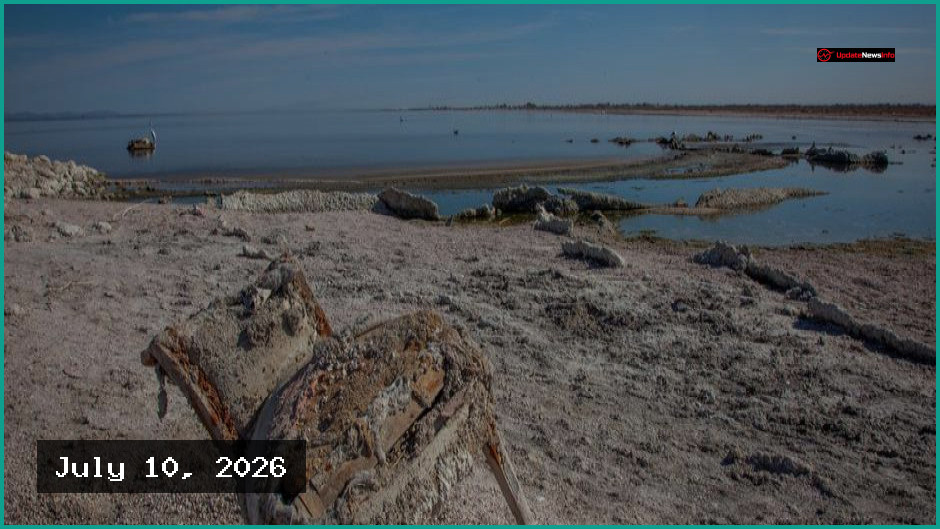
The Salton Sea, California's largest lake, is rapidly drying up, intensifying air pollution and posing severe health risks for communities living near its shores. Authorities are actively working to stabilize the exposed lakebed and mitigate the dust, but for some families, the damage is already profound.
Michelle Dugan-Delgado, 35, a resident of the Coachella Valley, has battled asthma for as long as she can remember. She consistently carries an inhaler and a face mask, a precaution against the sudden dust storms common in the region. “I know that it's not safe for me to go outside,” she told DW, describing her life as being “in a bubble” where she must constantly protect herself.
Inhaling dust can trigger an asthma attack, and the invisible bacteria, fungal spores, and viruses carried by the dust could lead to life-threatening infections.
Dugan-Delgado has been hospitalized multiple times due to these dangers, stating, “If I'm outside and a dust storm hits, there's a very high chance I'm going to catch something, which means I will end up in the hospital.”
The devastating impact of asthma has already struck her family. In 2009, her younger sister, Marie, died from an asthma attack at just 16 years old. “It wasn't anything that we thought would take her life away,” Dugan-Delgado shared, expressing the painful survivor's guilt she carries. She attributes the poor air quality in the Coachella Valley, an agricultural hub surrounded by desert and home to approximately 500,000 people, to her and Marie's illnesses.
Her own 13-year-old daughter also suffers from asthma, and her 11-year-old son has allergies. “The majority of families that I know will have at least one child with respiratory illnesses,” she added, calling it “heartbreaking.”
Studies tracking over 700 primary-school-aged children in the area revealed that 24% reported having asthma, significantly higher than the national rates of about 7% for boys and 5.5% for girls. More than 70% of these children also had allergies, exceeding the national average by over three times.
The primary culprit behind this dust is the Salton Sea itself. Spanning some 343 square miles (888 square kilometers), it is California's largest lake, but its rapid shrinkage exposes vast areas of parched sediment. When winds sweep across this exposed lakebed, they pick up not only dust but also pesticides and other toxic chemicals from agricultural runoff, further degrading the air quality.
The Salton Sea was formed by accident in 1905 when the Colorado River breached an irrigation canal gate, and its water levels have since been maintained by continuous agricultural runoff, irrigation wastewaters, and local rivers.
Amato Evan, a professor of climate science at the Scripps Institution of Oceanography at the University of California, San Diego, notes that climate change, driven by the burning of fossil fuels, is leading to hotter temperatures and prolonged droughts, making desert regions globally more arid. This makes it harder for plants to grow and stresses water resources, contributing to an increase in dust storms. “Dust storms are definitely becoming more frequent over time,” Evan stated.
Globally, at least a quarter of airborne dust originates from human activities such as off-roading, deforestation, and unsustainable agricultural practices like tilling and overgrazing. Drying lakes, from California's Salton Sea to Iran's Lake Urmia, are significant dust producers; for instance, the shrinking Aral Sea has made Central Asia 7% dustier over the past three decades.
While over half of the world's dust emissions come from the Sahara Desert, strong winds can carry this dust up to five miles into the sky, transporting it across vast distances, even across oceans.
The World Meteorological Organization reports that sand and dust storms affect approximately 330 million people annually, capable of engulfing entire cities, grounding flights, decimating crops, and causing deadly traffic accidents. The most severe impact, according to Evan, is on human health: “This is the number one adverse impact: it's humans breathing in dust.” Fine particulate matter can lodge deep in the lungs, leading to serious respiratory illnesses and heart disease, and is linked to about 721,000 deaths worldwide each year.
Children, the elderly, and individuals with pre-existing lung conditions are most vulnerable.
Despite the grim outlook, with the Salton Sea predicted to continue shrinking, state and local authorities have initiated projects to restore 30,000 acres of the lake's dusty shoreline by 2028. Efforts include laying thousands of hay bales to suppress dust, planting native vegetation to stabilize the soil, and pumping in water to create artificial wetlands for wildlife.
While Evan acknowledges that such initiatives can be effective against desertification, he cautions that they require substantial investment, water, and time—resources that are “not in infinite supply.”
Evan and his team are also developing an early warning system to alert communities about approaching dust storms, aiming for a system where people can get a “forecast for dust” similar to weather forecasts. Dugan-Delgado welcomes such a warning system and advocates for increased awareness about the risks of dust pollution, empowering others to protect themselves and their children, even as her own lungs continue to deteriorate.
More than half of the world's dust emissions come from the Sahara Desert in North Africa. If the wind is strong enough, that dust can rise up to 5 miles into the sky and travel over vast distances — across the Atlantic toward the Americas, or over the Mediterranean to Europe.
To view this video please enable JavaScript, and consider upgrading to a web browser that supports HTML5 video