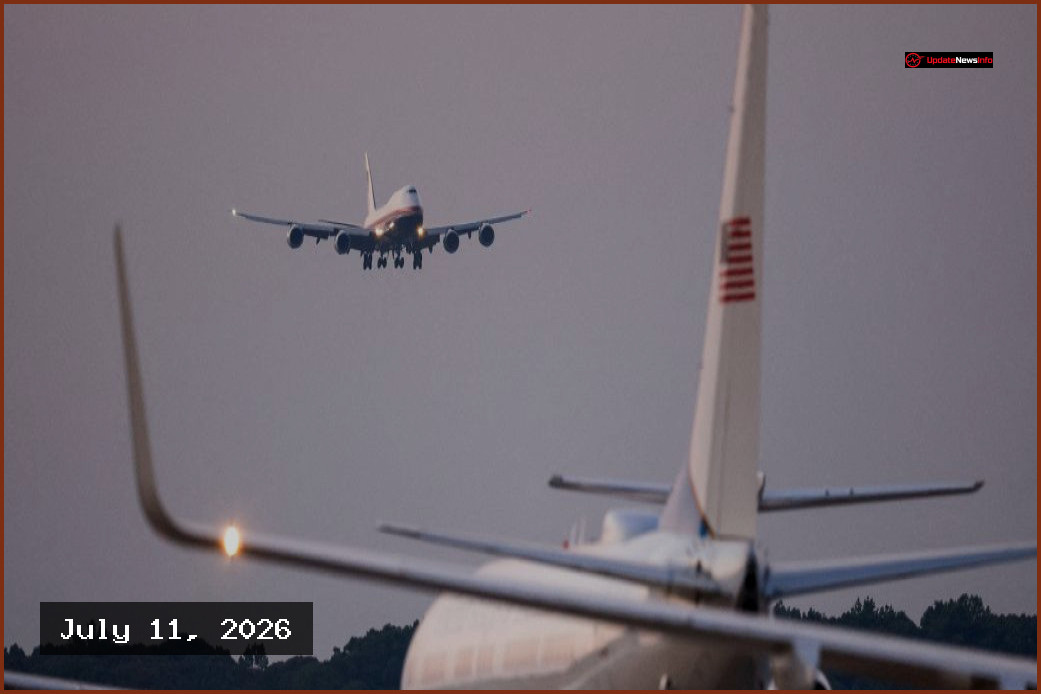
When President Donald Trump departed Turkey this week, he chose to board a 35-year-old modified Boeing 747 rather than the newly converted aircraft, introduced with much fanfare just days prior, that was parked nearby on the tarmac. This decision has intensified scrutiny of the Qatari-donated jet, which underwent conversion on an unusually compressed timeline, prompting questions about whether it received the necessary communications, security, and defensive upgrades to serve as the heavily fortified “flying White House.”
While sources told CNN there was no specific, new threat to Trump’s life, the president had mentioned the possibility of an assassination attempt from Iran during the NATO summit. The former Qatari jet had been flown by the president for the first time at the start of July, following approximately a year of upgrades and conversions. Trump had expressed a desire to have the new plane in the air by July 4, making his inaugural trip on it to Bismarck, North Dakota, on July 3, for the opening of the Theodore Roosevelt Presidential Library.
Several Republican senators have voiced misgivings about accepting the plane, citing potential security and legal risks. Ethical concerns also arose from Trump’s stated intention to send the plane to his presidential library after leaving office. At the plane’s unveiling on July 17, Trump declared, “There’s never been a plane like this ever built, and there will never be a plane like this built again.”
Despite the fanfare, the accelerated conversion process has led some aviation and security experts to question whether every critical upgrade was completed before the aircraft entered presidential service. Beyond its new paint scheme and larger size, the Boeing 747-800 aircraft features more fuel-efficient engines and an extended range.
The White House has not publicly detailed the defensive upgrades, but stated that changes focused on essential systems rather than cosmetic updates. A senior administration official told CNN, “By making minimal changes to the previous head-of-state interior, the Air Force fielded the aircraft faster without accepting any risk regarding security, safety, or secure communications.”
However, some experts are concerned that the roughly year-long effort to modify the aircraft may not have been sufficient to fully harden it for operations in high-threat airspace. Frank Kendall, the former Air Force secretary under the Biden administration, told CNN that it was a “schedule driven modification.” He added, “To do that, they would have had to leave out a lot of things that are on a regular Air Force One. You have to add all the things that are required for the president, and that’s why it takes so long and costs so much money. So, they did what they could with the time that they had.”
The specific defensive systems on the new plane remain unclear. While such systems might not be critical for a trip to North Dakota, flying in the Middle East poses different threats, particularly with ongoing conflicts involving missile activity. Boeing 747s are not typically equipped with missile countermeasures, though the older presidential fleet is widely believed to include them. Aviation observers who have studied images of the aircraft noted that the new plane appears to lack external modifications to the tail cone, which are associated with a type of directional infrared missile defense system. However, the absence of visible features does not definitively confirm which systems are or are not installed. The older planes are also believed to carry chaff, metallic strips used to confuse radar-guided missiles.
Secure communications are paramount, and antennas are critical for this, Kendall explained, noting, “You have to basically do structural changes to put the antennas in. Some of that, I’m sure they did. I’m not sure how much.” Furthermore, it is unclear what kind of defense the new jets possess against nuclear attacks and associated electromagnetic pulses, especially when compared to the older models designed during the Cold War era.
Richard Aboulafia, managing director of AeroDynamic Advisory, an aerospace management consulting firm, stated that the “inside” is what is “undoubtedly missing” from the aircraft, attributing this to insufficient budget and time. He emphasized the need to “Install an integrated and well fused electronic warfare and self-protection system, electronic countermeasures, chaff, even flare dispensers, whatever else.” Aboulafia also highlighted the necessity for “a very extensive communication suite, allowing encrypted communications with national and allied commanders all over the world,” describing it as an “extremely extensive and time-consuming process.”
Air Force One typically includes a medical suite capable of functioning as an operating room, with a doctor permanently on board, according to the White House. Kendall described Air Force One as a “flying White House,” encompassing communications, medical care, and critical security features fit for a president. He estimated that the Qatari jet would have required three to four years of modifications to meet the same standards as the older Boeing 747s. “I think in all three of those areas: the life support, the commander in chief support, the comms, and the security side, they probably did less by a substantial amount than a full-up Air Force One,” Kendall concluded.
Another notable difference is the new plane’s lack of aerial refueling capability, indicated by the absence of a bump on its nose. This seldom-used feature allows the old plane to take on fuel mid-air, providing a practically unlimited range. Interestingly, the new Boeing planes currently under development, which are intended to eventually replace the Qatari-donated jet, will also not possess this capability. Trump, however, maintained at the unveiling, “This plane is the first successful example of a real transformation of something that was built at the highest level and now had to be changed a little bit.”
CNN’s Kristen Holmes, Kevin Liptak, Holmes Lybrand, Alayna Treene, and Betsy Klein contributed to this report.
Scan the QR code to download the CNN app from the Apple Store.