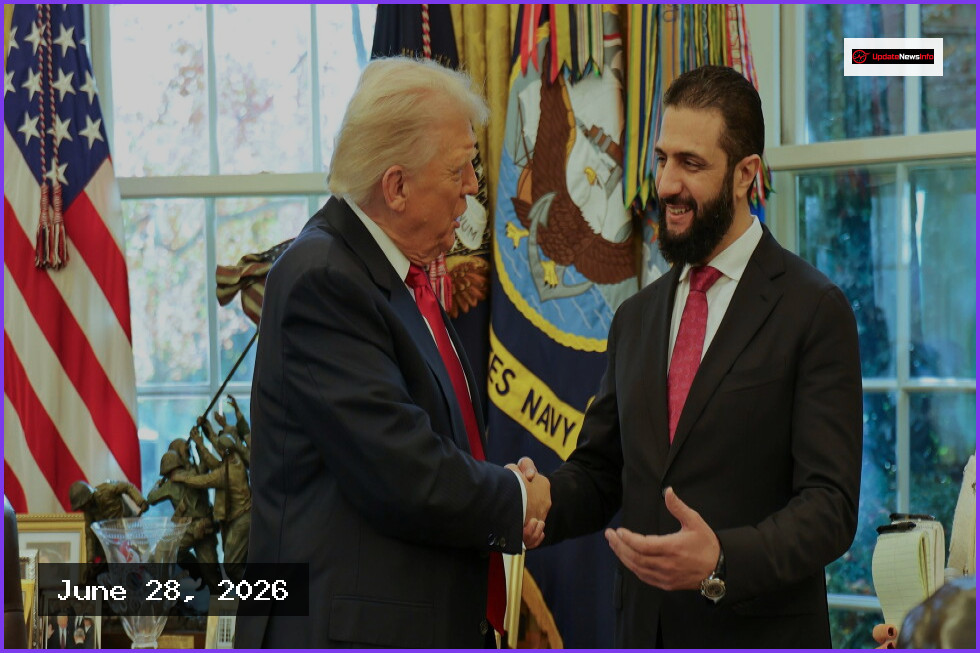
As the White House has grown dissatisfied with the ongoing conflict between Israel and the militant group Hezbollah in Lebanon, U.S. President Donald Trump has startled regional observers by proposing a new strategy: letting Syria confront the Iran-backed group instead. Trump has suggested that the battle-hardened, Islamist-led insurgents who deposed Syria’s autocratic leader Bashar Assad roughly 18 months ago—and subsequently formed a new government—would be more effective at rooting out Hezbollah than the Israeli military.
Syrian President Ahmad al-Sharaa has publicly stated he has no interest in such an intervention, asserting that the president’s comments were misunderstood. Despite these denials, Trump has reinforced the suggestion. The uncertainty regarding how seriously the White House is taking this proposal has triggered alarm in Lebanon and among Israeli officials, who view al-Sharaa’s government with deep suspicion. Israel has even seized a section of southern Syria since the new government took control. Syria has also emerged as a point of contention between Israel and Turkey, with both nations maneuvering to limit the other’s influence in the country.
Top Israeli security officials held a meeting on the matter on Wednesday, according to an official who spoke on the condition of anonymity because they were not authorized to discuss the topic. On the sidelines of the G7 summit earlier this month, Trump expressed that the war with Hezbollah is lasting too long and that “too many people are being killed.” Since Hezbollah entered the conflict on March 2, Israeli strikes in Lebanon have claimed more than 4,000 lives, including hundreds of women and children. Israel maintains that its operations are strictly targeting Hezbollah while taking steps to protect civilians.
Addressing the civilian toll, Trump stated, “You don’t have to knock down an apartment house every time you’re looking for somebody, because there are a lot of people in those apartment houses and they’re not all Hezbollah.” He added, “I suggested to Israel to let Syria take care of Hezbollah. ‘Cause to be honest with you, I think they’d do a better job.” Days later, during U.S.-Iran talks in Switzerland, Fox News’ Trey Yingst reported that Trump expressed frustration that Israel cannot effectively neutralize Hezbollah and noted he was considering giving the task to Syria, believing al-Sharaa would be more precise. The White House declined to comment further beyond the president’s previous remarks.
Syrian officials have worked to manage the fallout. During a speech in Damascus on June 13, al-Sharaa declared, “There are people spreading rumors that Syria will intervene in Lebanon. This is not true.” He emphasized a commitment to ending the war and fostering economic ties. In a June 21 interview with the Emirati network Al Mashhad, al-Sharaa insisted the remarks were misconstrued, stating that Syria had presented a vision for a peaceful solution to the United States. During the 14-year Syrian civil war, Hezbollah had backed the Assad regime against insurgents like al-Sharaa. Since taking power in December 2024, the new leadership has maintained they want to focus on domestic rebuilding and avoid regional conflicts.
Although Syria remained on the sidelines during the recent war between Israel and Iran, it did send military reinforcements to the Lebanese border in the early stages to prevent arms smuggling or conflict spillover. In March, Syria accused Hezbollah of firing artillery toward its positions, which the group denied, and Turkey later intervened to defuse tensions. Randa Slim of the Stimson Center warned that Trump’s proposal ignores the reality that Syria is struggling to rebuild and manage millions of refugees, noting its military forces are not a coherent institution. The proposal has also reignited fears in Lebanon linked to the memory of the Syrian occupation that ended in 2005.