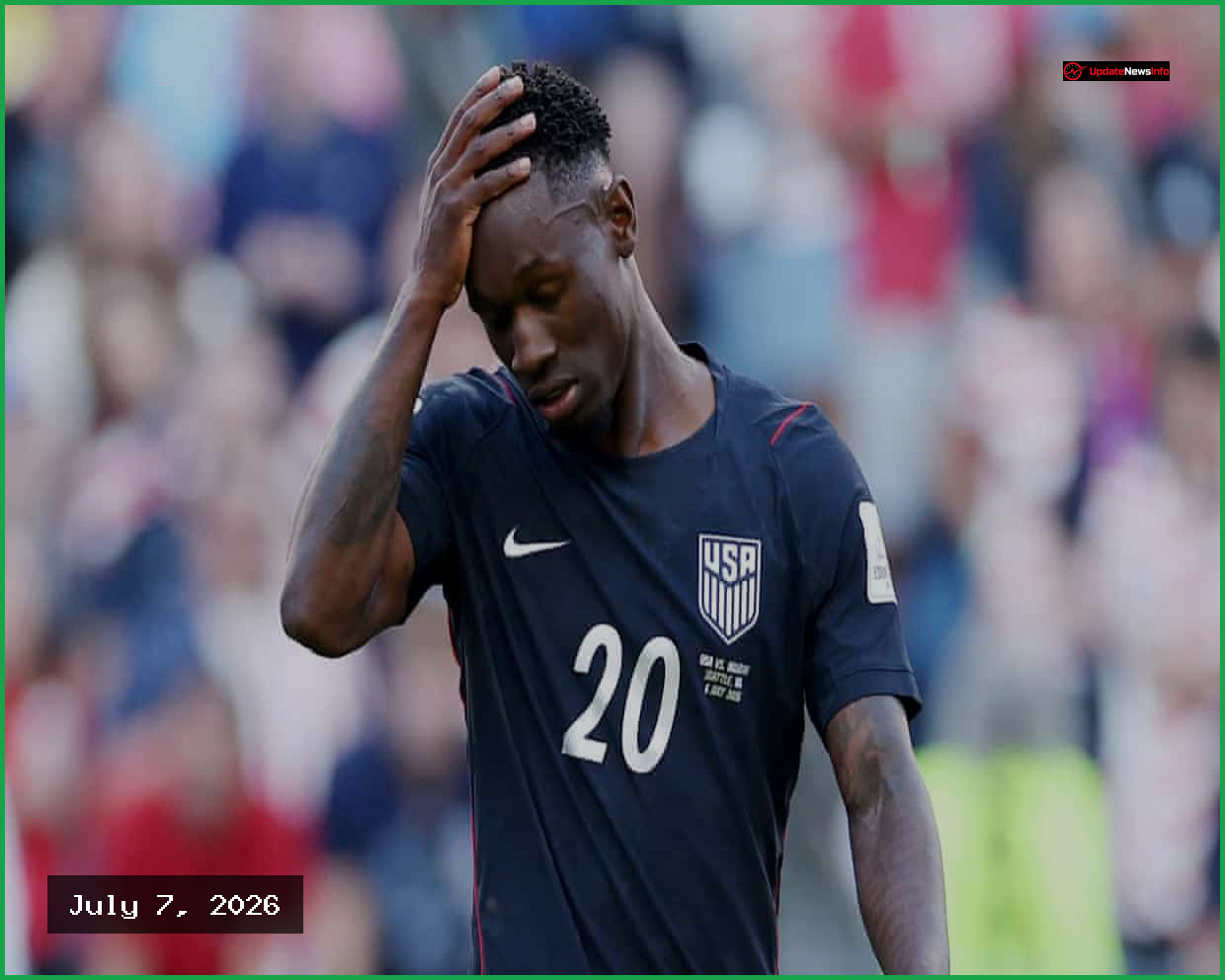
The United States’ campaign at the 2026 World Cup came to a disappointing conclusion on Monday as the team suffered a 4-1 defeat to Belgium in the last 16. The loss, which occurred in the Pacific north-west, mirrors the exit stage of the team’s three previous World Cup appearances, leaving supporters to ponder what might have been after a tournament that initially showed great promise.
Despite the team’s history of high-quality play and defensive resilience earlier in the competition, the match against Belgium was defined by defensive lapses and costly individual errors. US coach Mauricio Pochettino admitted after the game that his side failed to connect with the match properly, noting that even after scoring, they immediately conceded again. Pochettino offered congratulations to Belgium, acknowledging they were the superior side on the evening.
Belgium opened the scoring through Charles De Ketelaere, who finished a sequence initiated by a long ball that bypassed the US defense. Although Malik Tillman briefly leveled the score for the US with a well-placed free-kick—marking his second goal from a direct free-kick in the tournament—the momentum was short-lived. Belgium reclaimed the lead shortly after when De Ketelaere headed in a cross from Leandro Trossard.
Because though there were fleeting moments of hope, this US performance paled in comparison to those that set the world on notice earlier in this competition. No US team has looked better at a World Cup. No US team before scored goals like the ones they did – goals of quality and ingenuity. No US team before defended quite this capably, over such long periods of time.
The match was effectively sealed in the 57th minute by a significant error from US goalkeeper Matt Freese. Yet it ended with missed defensive assignments, poor giveaways and a moment of pure panic from the goalkeeper Matt Freese that sealed the US’s fate. After chesting a ball away from De Ketelaere, Freese hesitated and failed to clear the danger, allowing Hans Vanaken to roll the ball into an open net from distance. Romelu Lukaku, who entered as a substitute in the 67th minute, added a final goal in stoppage time to complete the 4-1 scoreline.
The defeat followed a turbulent 36 hours for the US squad, which included ongoing discussions regarding the status of striker Folarin Balogun. Given the events of the previous 36 hours, the US lineup came as no surprise. There was Balogun, starting up top in the same XI that so impressed against Paraguay and Bosnia and Herzegovina. His presence was always expected after his controversial, Trump-driven reinstatement. However, the team struggled throughout the night with poor giveaways and missed assignments, with key players like Weston McKennie, Christian Pulisic, and Chris Richards unable to maintain their usual form under the pressure exerted by the Belgian side.
The US can’t claim there weren’t warning signs. In the eighth minute, Amadou Onana shrugged off several challenges and slipped the ball through to Lukébakio. The winger knifed through the US defense, sending a nice ball across the face of goal that Youri Tielemans scuffed. The danger had passed, but not for long.
Pochettino attempted to kickstart things in the second half by bringing on Gio Reyna in place of Sergiño Dest. But the US’s bright start was eventually overshadowed by the cruelest of goalkeeping errors. It wasn’t immediately clear why Freese came so far off his line to meet a long ball in the 57th minute, or why he hesitated to clear the ball after chesting it away from De Ketelaere. But the end result was a clear chance for Vanaken, who rolled the ball into an open net from distance. Freese and Ream were left with their heads in their hands.
It was dreamland to reality check. The US had gone from confident, to controversial, to overawed. The swashbuckling side had faded under the cool, shady clouds that tend to greet every day here along Puget Sound. US fans will only hope that the skies open again four years from now, delivering a side who have fully moved on from whatever Monday was.