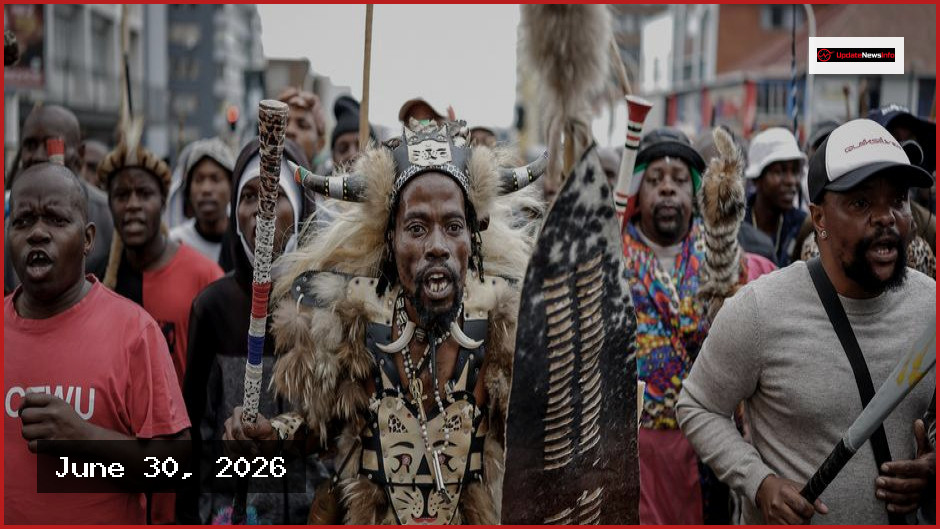
Anti-immigrant groups have designated June 30 as an unofficial deadline for undocumented migrants to depart South Africa, with protests currently unfolding across the country. While authorities have reported that demonstrations have been largely peaceful, the nation is bracing for potential unrest. In Johannesburg, protesters have marched through the Hillbrow and Yeoville neighborhoods, where some smaller groups were spotted throwing stones at windows. Police and private security forces remain highly visible across the city.
South Africa’s Ministry of Police has issued an interim report acknowledging incidents of looting and attempted looting during the demonstrations. Officials confirmed that several people have been arrested. Police are currently on high alert, with forces deployed in significant numbers to ensure public safety, guard businesses, and protect critical infrastructure. Deputy Police Minister Firoz Chachalia warned that anyone using these protests as an opportunity to commit crimes will face the full power of the law. He emphasized that acts of violence, intimidation, and the destruction of property will not be tolerated.
The city center of Johannesburg and its surrounding areas are unusually quiet, with many businesses in Fordsburg, Newtown, and the Oriental Plaza remaining closed. Police have gathered at a staging ground in Mayfair to oversee the marches. Acting police commissioner Puleng Dimpane affirmed the readiness of the police to maintain national safety. President Cyril Ramaphosa, in his weekly newsletter, acknowledged public concerns regarding illegal immigration and border management but urged protesters to act peacefully. He emphasized that constitutional rights do not extend to violence or vandalism, and he explicitly rejected vigilantism.
South Africa, a nation of 65.5 million people, has long been a destination for migrants, with current estimates suggesting between 2.4 million and 3.1 million foreign-born residents. However, high unemployment and deep inequality have fueled public frustration. A poll from the Human Sciences Research Council indicated that only one in six adults would welcome all foreigners, while 42% stated they would welcome none—a significant increase from one-third in 2021. The country has a history of anti-migrant violence, including riots in 2008 that resulted in 62 deaths.
Thousands of migrants, primarily from Malawi and Zimbabwe, are currently seeking assistance to return to their home countries, with some reporting evictions or job losses due to the current climate of intimidation. Several governments, including those of Nigeria, Ghana, and Malawi, have organized repatriation efforts. Tensions remain elevated, as three individuals—one Malawian and two Mozambican nationals—were killed in the lead-up to this deadline. Reports have also surfaced of intimidation at schools and obstacles preventing migrants from accessing hospitals.