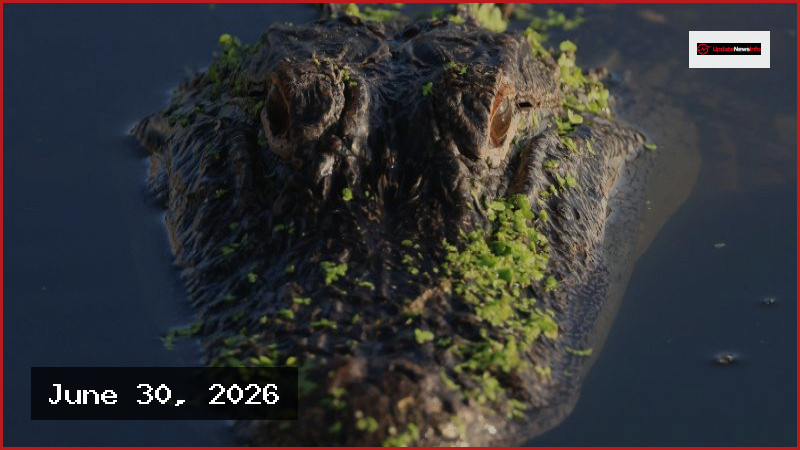
Central Florida has experienced a series of concerning alligator attacks over the past week, including a fatal encounter that claimed the life of a 31-year-old woman. While experts from the Florida Fish and Wildlife Conservation Commission (FWC) note that serious incidents involving alligators remain relatively rare, the state has seen three separate attacks within the last seven days, with two occurring in a span of just 24 hours.
The most recent incident occurred on Sunday afternoon in the Econlockhatchee River, just north of Orlando. According to FWC officials, the victim was swimming with her boyfriend and a friend when she was bitten by an alligator. Despite her boyfriend’s efforts to intervene and pull her from the animal’s grip, the woman sustained severe injuries to both arms. She was transported to a hospital where she later passed away. Following the attack, FWC officials captured a 13-foot alligator at the site and a 12-foot specimen nearby, both of which are being considered as potentially responsible for the tragedy.
This fatality follows a separate incident just 24 hours earlier, where a young boy fishing with his father was bitten on the hand at Nelson’s Fish Camp in Marion County. Wildlife officials subsequently captured and euthanized an 8-foot-7-inch alligator linked to that attack. Additionally, a snorkeler was bitten on June 21 at the Rainbow River, roughly 100 miles away from the location of Sunday’s deadly attack. Authorities had temporarily closed that waterway before removing the offending alligator.
Florida hosts an estimated 1.3 million alligators, yet unprovoked bites are statistically uncommon, averaging about eight per year. Since 1948, over 450 such incidents have been documented in the state, with 30 proving fatal. Last year, there were 13 recorded attacks, resulting in two deaths, eight major injuries, and five minor ones.
Research conducted by the University of Florida and Centre College suggests that human behavior plays a significant role in these encounters. The study indicates that remaining on land or walking near the water carries a low risk, whereas deliberately entering waterways known to inhabit alligators constitutes high-risk behavior. Dr. Frank Mazzotti, a professor of wildlife ecology at the University of Florida, emphasized that maintaining situational awareness and avoiding risky activities in alligator habitats are essential measures for both human and wildlife protection.