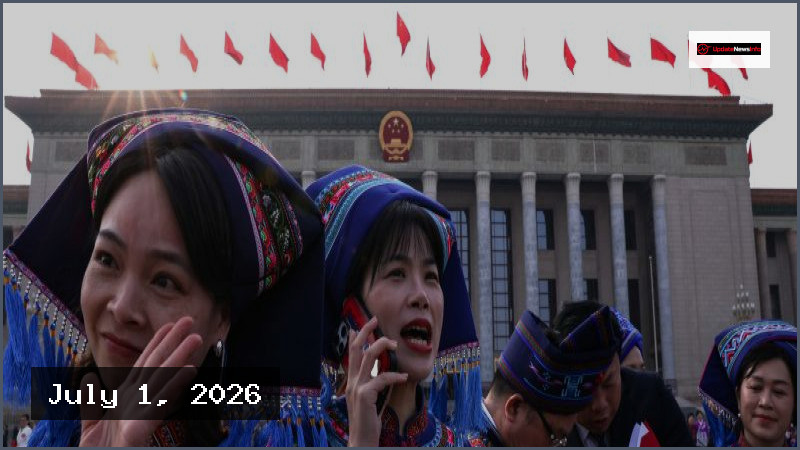
For years, Chinese leader Xi Jinping has pushed ethnic minority groups like Tibetans and Uyghurs to adopt an identity rooted in Chinese nationality and allegiance to the ruling Communist Party. Now, that push has been codified into a sweeping new law that reaches into classrooms, neighborhoods and homes – and gives Beijing the right to target people outside of its borders that it believes violate its rules. The statute, officially known as the Ethnic Unity and Progress Promotion Law, came into effect on July 1. It bans acts that “undermine ethnic unity or create ethnic division” among China’s 56 officially recognized ethnicities, which include a Han Chinese majority that makes up over 90% of the country’s 1.4 billion people.
Under the new rules, schools and government agencies must use Mandarin Chinese as their primary language; classrooms must ensure that their curriculum “forges a strong sense of the community of the Chinese people,” and all parents must guide children to “love the Chinese Communist Party and the Chinese people.” The state is mandated to support museums, libraries and other cultural institutions to hold events reflecting Chinese history and national prosperity, while local authorities must work toward ethnic integration in their housing policies – a stipulation observers suggest could lead to housing relocations.
Organizations and individuals outside mainland China that “undermine” ethnic unity or “create ethnic division” will also be held liable, the law says – a broad-based stipulation that critics say will impact activism, research and discussion of ethnic minority issues globally. In an address marking the 105th anniversary of the founding of the Chinese Communist Party on Wednesday, Xi emphasized the law’s importance by calling on all party members to “continuously consolidate and strengthen the great unity of all ethnic groups.”
The legislation has already drawn criticism from rights groups and experts, who say that it could suppress minority cultural identity, religious practice and language. In an April letter, United Nations human rights experts said the law “could have serious implications for the linguistic, cultural, and religious autonomy of ethnic communities, including Tibetans, Uyghurs, and Mongols.” They also warned of the potential for “transnational repression,” given that the law may be applied overseas. For some observers, the law appears to be a final step in a years-long evolution of Chinese policy to emphasize national identity over ethnic autonomy. It is also widely seen as part of a broader vision to ensure national security under Xi, who came to power in 2012 following widespread 2008 protests in Tibet and deadly unrest in Xinjiang.
With the new law, “Beijing is no longer treating ‘ethnic unity’ as a general political slogan or a matter of local propaganda work,” said James Leibold, a professor at La Trobe University in Melbourne. “It is making the production of a single Chinese national identity a binding responsibility across schools, families, media, museums, cadres, budgets, technology platforms and security organs,” he added. Leibold warns of a likely “chilling effect” on overseas scholars and activists, which could lead to self-censorship and narrowed scholarly debate. In recent years, China has ramped up oversight of religious institutions and restricted minority languages. It has faced accusations of human rights violations, including large-scale detention in Xinjiang, and the existence of over 100 alleged overseas police stations, according to a 2022 report from Safeguard Defenders, though Beijing denies these claims.
Beijing insists its new law protects the rights of all ethnic groups. Vice Minister of Justice Hu Weilie stated that the law aligns with international norms, emphasizing that ethnic unity is a “crucial cornerstone of national prosperity,” and that illegal activities inciting tension will be addressed to protect national security.