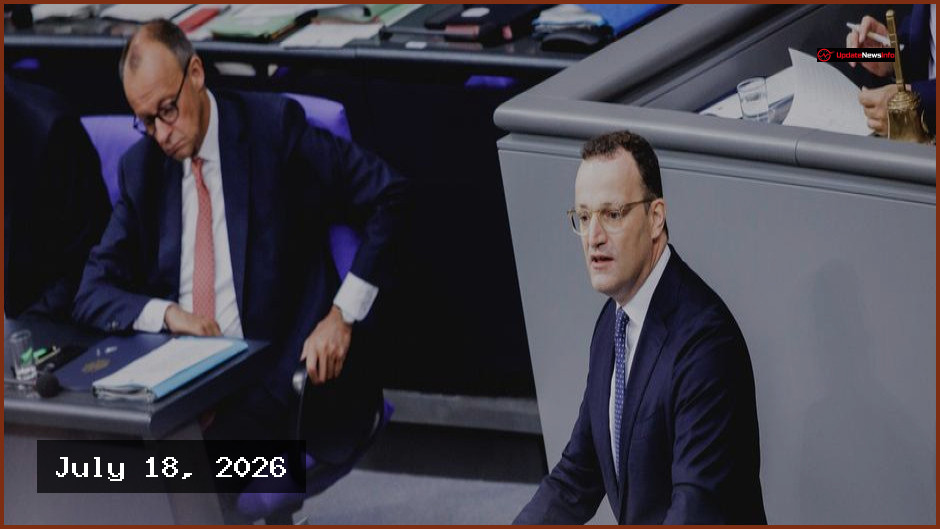
Jens Spahn, a key ally of Chancellor Friedrich Merz and the chair of the center-right Christian Democratic Union (CDU) faction in the German parliament, has officially stepped down from his leadership post. His resignation, announced on Saturday, follows a mounting political controversy regarding his decision to have a child via a surrogate mother in the United States, a practice that remains strictly prohibited under German law.
In a letter addressed to his colleagues, Spahn reflected on the situation, stating that he had come to realize his personal happiness in starting a family with his husband and becoming a father was ultimately incompatible with his political office. Earlier in the week, Spahn and his husband, Daniel Funke, announced the arrival of their child.
Spahn told the German mass-circulation tabloid BILD that it was difficult to put the feeling into words, adding that his husband had become a dad, and so had he, describing their child, Georg, as their "whole world."
The news immediately ignited a heated political debate because the procedure used by the couple is illegal in Germany. The CDU, Spahn’s own party, has long maintained a staunch opposition to the legalization of surrogacy. As recently as February, the party reaffirmed this stance during a federal party convention, passing a resolution that demanded surrogacy—including altruistic models—remain banned to prevent potential abuse, exploitation, and health risks.
Notably, Spahn was present at that convention, at which time a surrogate mother in the US was already pregnant with his and his husband's child.
While Spahn and his husband do not face legal consequences because the surrogacy took place in the US, the situation has triggered widespread accusations of double standards. In Germany, only the doctors and intermediaries involved in such arrangements would be liable for prosecution, and it is not illegal to raise a child born abroad via a surrogate. However, critics have pointed to Spahn’s long history of opposing the practice.
In 2015, he told GQ magazine that as a gay man and a Christian, he found the idea of a "rented womb" difficult to accept. Furthermore, in 2020, while serving as federal health minister, he blocked efforts by the neoliberal Free Democratic Party to liberalize surrogacy laws, citing concerns that the practice could lead to "particular difficulties in the child's sense of identity."
The backlash was significant, with Daniel Peters, head of the CDU in the state of Mecklenburg-Western Pomerania, publicly calling for Spahn’s resignation. Peters told BILD that Spahn was no longer acceptable as chairman of the Union parliamentary group, arguing that as a leader, he held a special role as a role model.
Peters claimed that by using a surrogate mother, Spahn had "deliberately flouted the law that's in force in Germany" and that his attempt to separate his private life from his political position was "absolutely unacceptable."
Other voices within the political sphere echoed this criticism. Hubert Hüppe, chairman of the CDU seniors' organization, told Focus magazine that he was shocked, stating that it was not right for politicians to use their power and money to circumvent a ban that is rightly in place.
Opposition members also weighed in, with Kathrin Gebel, spokesperson for women's issues for the socialist Left Party, arguing that political standards should apply to private life as well.
Janosch Dahmen, the health policy spokesperson for the Greens, accused Spahn of double standards, questioning why a politician who promotes specific regulations would act as though they do not apply to him personally.
Spahn, 46, has previously weathered various political scandals, most notably the controversy surrounding the overpriced purchase of protective face masks during the COVID-19 pandemic, which resulted in legal disputes with suppliers worth billions. Despite that ongoing issue, he had remained a politically influential figure until this latest resignation.
To view this video please enable JavaScript, and consider upgrading to a web browser that supports HTML5 video
July 18, 2026: This article has been updated with the news of Spahn's resignation.