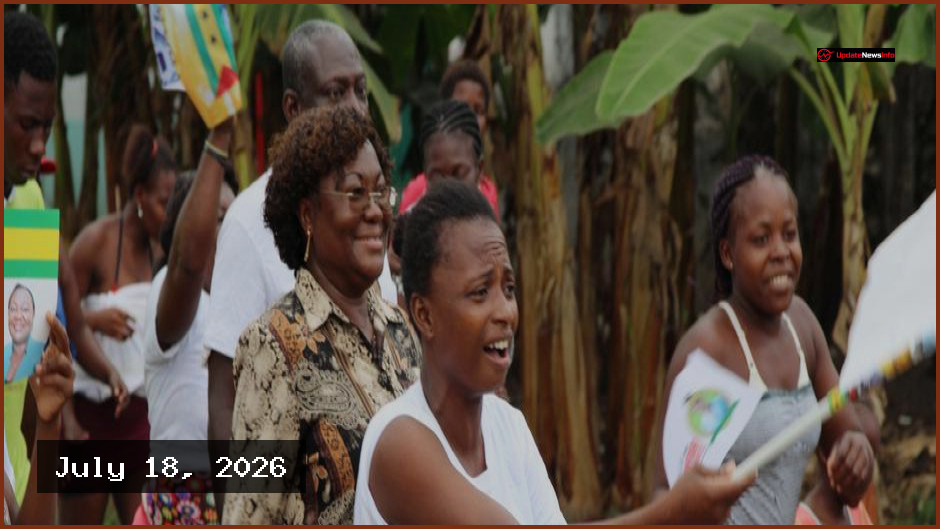
Voters in the island nation of Sao Tome and Principe are heading to the polls this Sunday to elect a new president, a pivotal domestic event that precedes parliamentary elections scheduled for the end of September. For the archipelago, which has a population of just 245,000, these elections are drawing significant international scrutiny. This heightened attention is largely due to the nation's strategic location in the Gulf of Guinea and a military cooperation agreement signed with Russia in April 2024.
The agreement with Moscow, which covers military training, technical assistance, cooperation on arms and military equipment, intelligence sharing, and reciprocal visits by naval vessels and military aircraft, has been closely monitored by the United States and European nations. These Western powers have historically served as the country's most important security and development partners. Alongside the military pact, a separate accord was also signed between Russia's Interior Ministry and the national police force of Sao Tome and Principe.
However, political analyst Arzemiro dos Prazeres, a former politician and president of the parliament, believes the geopolitical significance of the Russian deal has been frequently overstated. According to him, the agreement has remained largely ineffective and has never been implemented. He argued that nothing has actually been put into practice, and he agrees with former Prime Minister Patrice Trovoada that this is a perfectly ordinary military agreement, similar to those the nation has signed with the European Union, Brazil, Angola, or Portugal. He noted that the real issue was the timing of the agreement, which triggered considerable controversy given Russia's ongoing war in Ukraine.
Elsa Pinto, a former Foreign Minister, emphasized that the country’s strategic importance is not a new development. She noted that the archipelago has served as a vital hub for centuries, from its history as a major center for sugar production and the world's largest cocoa producer to its role as an important hub in the trans-Atlantic slave trade. Today, its location on the equator in the Gulf of Guinea, a region crossed by major international shipping lanes and home to significant oil and gas reserves, makes it a security hot spot. Piracy, organized crime, and the protection of maritime trade routes have further cemented its importance. Pinto stated that major commercial and military routes pass through the country's waters, a reality that has persisted since the colonial era.
Despite the international focus on the Russian agreement, Pinto rejects the notion that the nation is pivoting away from the West. She maintained that the country’s foreign policy remains rooted in non-interference and the principles of the African Union and the United Nations. She emphasized that the nation wants to maintain good relations with all countries, including the United States, Europe, Russia, and China. She does not expect the elections to produce any major shift in foreign policy, as the country will continue cooperating with both Western and Eastern partners. This approach reflects the nation's diplomatic evolution since its independence in 1975, when it initially aligned with the Soviet Union before transitioning to a multiparty democracy in the early 1990s.
The presidential race features four candidates, though incumbent Carlos Vila Nova is widely considered the clear front-runner. His campaign has focused on themes of national unity and political stability. Former Prime Minister Jorge Bom Jesus, who was seen as a key challenger, withdrew from the race, citing an "avalanche of criminal falsehoods" and a climate of "division and political tension" surrounding his candidacy. Analysts like dos Prazeres expect the election to conclude in the first round, making a runoff unnecessary. Under the nation’s semi-presidential system, the president holds significant constitutional powers, including appointing the prime minister, vetoing legislation, dissolving parliament, and serving as commander-in-chief of the armed forces.
To ensure the integrity of the process, the European Union has deployed an election observation mission. Its chief observer, Portuguese member of the European Parliament Sergio Humberto, said the mission aims to help ensure a transparent and peaceful electoral process. As the nation recently marked its 51st anniversary of independence on July 12, it continues to navigate the complex interests of global powers. For Sao Tome and Principe, the priority remains to secure investment, development assistance, and security cooperation with as many partners as possible, even as it becomes an arena for competition between major powers.
To view this video please enable JavaScript, and consider upgrading to a web browser that supports HTML5 video
That's why the upcoming presidential and parliamentary elections are about far more than domestic politics. They are taking place at a time when even the world's smallest states are increasingly becoming arenas for competition between major powers.