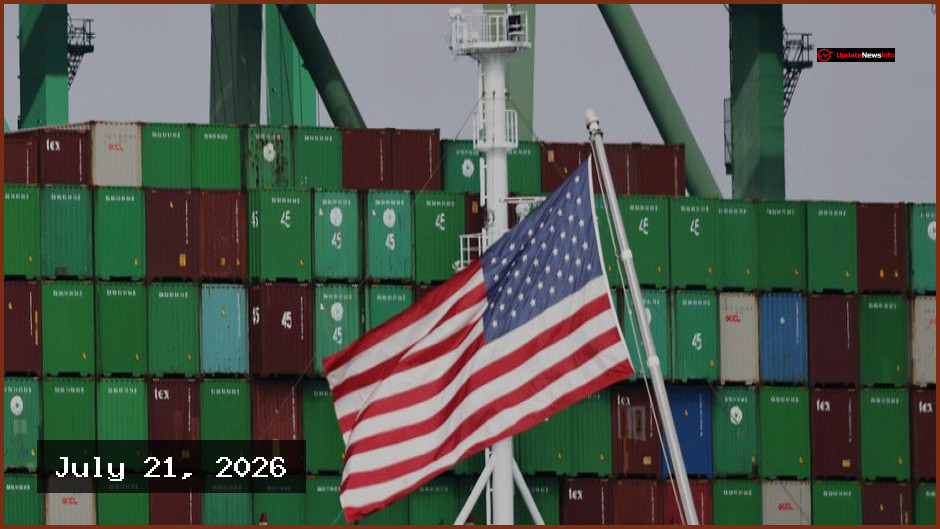
The administration of US President Donald Trump announced on Monday the implementation of 50% tariffs on a wide array of Canadian goods. These new trade measures, which cover products ranging from wine and hockey sticks to cement, are scheduled to take effect in 30 days. The action was formalized through three proclamations signed by President Trump under Section 338 of the Tariff Act of 1930, a nearly century-old law that grants the authority to impose tariffs of up to 50% on imports from specific countries.
According to the White House, the decision serves as a direct response to what it termed Canada's discriminatory treatment of American goods. The administration specifically cited Canadian tariffs and quotas on US-manufactured cars that are not applied to vehicles from other nations. Furthermore, the White House noted that all but two Canadian states and territories have restricted the distribution of American alcohol. Despite these new measures, the tariffs will not apply to energy, potash used in agricultural fertilizer, fish, critical minerals, or goods already subject to existing Section 232 national security tariffs.
Canadian Prime Minister Mark Carney stated that the US tariffs are in direct violation of the Canada-United States-Mexico Agreement (CUSMA). He indicated that Canada has already proposed plans to modernize the agreement and remains ready to intensify those discussions in the coming weeks. Ontario Premier Doug Ford also condemned the proposed tariffs, warning of significant economic consequences for both sides of the border. In a post on X, Ford vowed to advocate for Ontario's interests, suggesting that Canada should respond with equivalent countermeasures, stating, “I’ll never stop fighting to protect Ontario. If these tariffs proceed, Canada should respond tariff for tariff, dollar for dollar.”
Scott Lincicome, vice president of general economics at the Cato Institute in Washington, D.C., warned that the measures would inject massive uncertainty into the global economy and impact various US trading partners. Describing the use of Section 338 as the nuclear option for Trump tariffs, Lincicome noted that the move represents a significant escalation in trade policy. Additionally, President Trump has suggested the possibility of further tariffs in response to Canadian wildfire smoke that has affected air quality in parts of the United States. While President Trump and Prime Minister Carney recently attended the FIFA Club World Cup final together, US officials clarified that the meeting was not intended to address trade issues.
She urged both countries to use the 30-day period before they take effect "to make meaningful progress in advancing formal talks."
To view this video please enable JavaScript, and consider upgrading to a web browser that supports HTML5 video