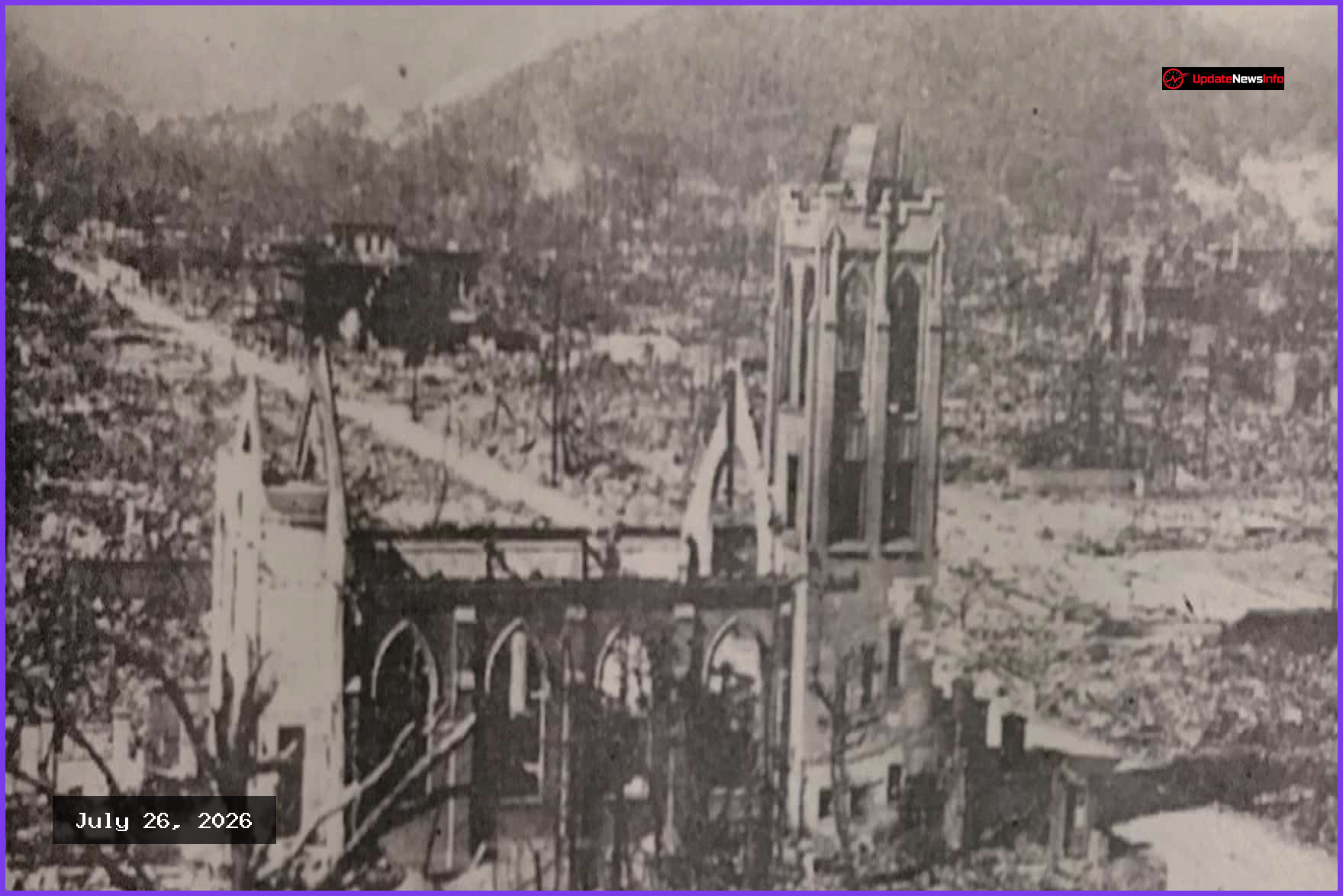
A newly unearthed memoir by Kiyoshi Tanimoto offers a chilling, firsthand account of the immediate aftermath of the atomic bomb that fell on Hiroshima. Tanimoto, who served as a neighborhood defense coordinator, captures the confusion and terror of a city that had little warning of the impending catastrophe. Most residents had neither seen nor heard any aircraft, nor did they hear the sound of an explosion; they witnessed only a strange flash in the daylight or felt its reflection. However, the impact was catastrophic.
The parents of Mr. Konda, a member of Tanimoto’s church, were waiting for a train at Yokogawa station, situated 2km (one and a quarter miles) from the center of the blast. They observed a B-29 aircraft and a parachute descending before losing consciousness. Upon waking, they found themselves burned and without clothing, surrounded by crushed houses, and fled toward the suburbs along the Koi highway, a path taken by many others in the same state.
As Tanimoto crossed the Koi and Fukushima bridges, he reached a location about a kilometer from the explosion. While houses in the suburbs remained standing despite heavy damage, those from this point toward the center of the blast were flattened as if crushed by a hammer. The air was filled with the painful cries of "Tasukete!"—meaning "Help!"—emanating from beneath the wreckage. Tanimoto noted that because he had previously assisted with clearing houses, he knew the immense difficulty of removing even a single log from a collapsed structure. Despite seeing people buried everywhere, he realized that as a single person, he was powerless to rescue them.
The realization that his own wife, baby, and the 120 neighbors entrusted to his care as a defense coordinator might be in similar danger overwhelmed him. He described running "like a wild man" in tears, apologizing to the victims he could not assist. At the Fukushima bridge, he encountered Mr. Matsuo, who had been with him when the bomb exploded, but Tanimoto continued his frantic search, following the riverbank to find a path away from the most intense fires. He eventually reached Nakahiromachi, a northern neighborhood with more farm fields and fewer houses.
In this area, he encountered countless pitifully injured people lying in the streets, unable to move. Overcome by survivor's guilt, he threw his panama hat to the ground and asked for forgiveness for being uninjured while his family might be trapped under their home. He attempted to reach his neighborhood of Noboricho by crossing the Ota River, as the usual route via the Misasa Bridge was engulfed in flames. He plunged into the river, but exhausted from running for an hour, he struggled to swim. He began to swallow water and feared he was drowning, praying to God to protect his body until he could save his wife and child. He eventually discarded his gaiters, coat, and a shoe to lighten his load and managed to swim across.
After passing through the relatively unscathed Ushita district, he arrived at his home to find it destroyed. His wife, who had been buried instantly under the house, survived by struggling to clear a small hole in the attic. Despite being pinned by heavy wood, she managed to free one arm and widen the opening. She used the sound of their baby, Koko, crying to keep herself conscious and eventually pushed the child through the hole before freeing herself. By the time she emerged, the neighboring house was on fire. She escaped with Koko to the Sentei gardens, though she remained deeply distressed about their neighbor, Mrs. Takaki, who had been with her when the house collapsed.
‘I didn’t want to be a victim of the bomb’: read an interview with Tanimoto’s daughter Koko Kondo
In a determined manner, I plunged into the river. It was not that I had confidence in my swimming ability, but there were no other means of reaching my goal. The Ota River varies in water level according to the tides. There was not much water, but the stream was swift. Naturally, I lost control of my limbs. I had already run continuously for about an hour and was dead tired.