More than 1,500 pages from the personal diary of 85-year-old former National Institute of Allergy and Infectious Diseases director Dr. Anthony Fauci have entered the public record. Obtained through a subpoena, the documents were released by U.S. Sen. Rand Paul, R-Kentucky. The entries, which span from 2001 to 2015 and from January 2020 through December 2022, offer a detailed look into the immunologist’s perspective on the COVID-19 pandemic, his interactions with President Donald Trump, and his sudden ascent to global celebrity status.
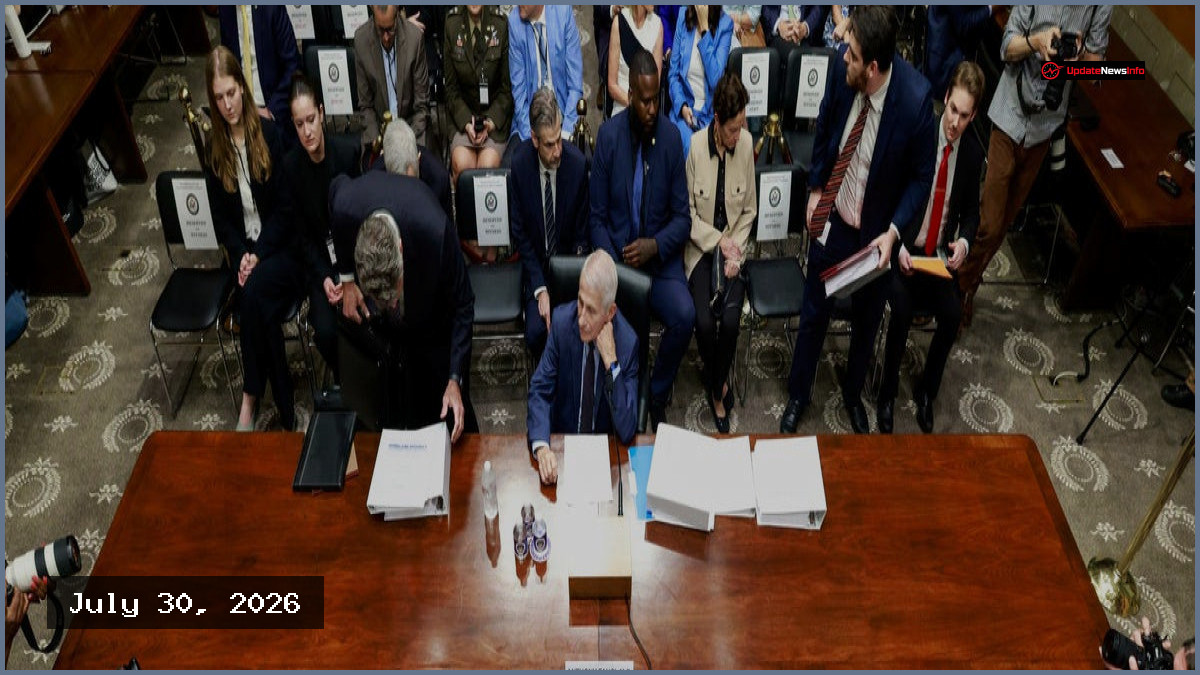
The release comes amid renewed scrutiny of Fauci’s tenure. During a July 29 Senate hearing, the former director repeatedly invoked his 5th Amendment constitutional right against self-incrimination. The global impact of the pandemic he managed remains significant, with the World Health Organization estimating that over 7 million people have died worldwide, including 1.2 million in the United States.
Fauci’s early 2020 entries reflect the initial confusion and scientific inquiry surrounding the virus. On January 3, 2020, he documented “unusual cases of pneumonia” in Wuhan. He entered almost daily updates on COVID-19, including case counts and entry of travelers. By late January, he was addressing “conspiracy theories” regarding whether the virus was manufactured and released intentionally or unintentionally.
He noted: “I suggest that we get a larger group of qualified evolutionary biologists/virologists together under the auspices of a convening body and carefully look at this.
We agreed to convene by phone the next day.” Throughout 2021, Fauci pushed back against claims from Republicans, including Paul, that American funding for the Wuhan Institute of Virology contributed to the virus's creation, labeling such theories “molecularly impossible.” By August 2021, he wrote that Republican efforts to blame the lab were “based on no new information or data” and characterized the attacks as “a concerted effort aimed at getting trump reelected and exonerating him from any blame in the complete mess up of his response to COVID-19.”
The origins of the virus remained a point of debate in his writings. A 2022 study provided evidence that the coronavirus originated in animals at a seafood market and suggested further study. The World Health Organization issued a report in 2025 saying it had more understanding of the virus' origins, but needed more information, and China wouldn't provide it. In 2025, the CIA said it was “more likely” the virus came from a lab than nature, though it said it had “low confidence” in its assessment.
School closures emerged as a major point of contention in his writings. In late January 2020, Fauci wrote about Chinese officials closing schools, and he began referencing Americans needing to close schools when the virus arrived in the country. On March 15, around the time cities and states began lockdown orders, Fauci brought up his conversations with former New York City Mayor Bill de Blasio and California Gov. Gavin Newsom about closing schools in both Democratic-controlled jurisdictions.
A day later, he said he formulated a “more aggressive mitigation” 15-day strategy that included closing schools. Later, in April, he referenced conversations with Florida Gov. Ron DeSantis, a Republican, who wanted to keep schools open, but he said DeSantis later called and said he was evaluating the situation. Fauci clarified to Mark Meadows, the president's top aide, that he never said not to open schools, but that a vaccine should be ready when schools are reopened.
Still, in early July, Fauci said, "Trump wants to open the schools at all costs. Clearly he does not care about the safety of the chidren.” By August, he acknowledged the default position should be to reopen schools because of the “psychological effects on children,” as well as children depending on school breakfasts and lunches for meals, and the effect on working families.
But he said the primary consideration should be on health, safety and welfare of children and teachers, and spread to their families. “I have stated that one size does not fit all and decisions should be based on the level of infection in the community,” he said.
Fauci’s diary frequently criticized President Trump. In different passages, Fauci said Trump was "out of control," a "true embarrassment,” and “a very strange guy.” On May 22, 2020, he wrote: "Trump getting out of control in pushing to open up the country and get the economy back before election day. He is desparate. This is all about re-election.” In the summer, he wrote about his relationship with Trump, in which the president was “Okay” with Fauci in person and telling reporters their relationship is fine but then retweeting posts attacking Fauci.
“He is a very strange guy," Fauci wrote in a July 28, 2020, diary entry. Days before the 2020 election, Fauci said on Oct. 15: "As the election nears, the cases increase and surges are inevitable as we enter cooler weather. Trump is on the campaign trail spewing nonsense. He is really out of control. A true embarrassment."
The diary also documents Fauci’s transition from a long-serving researcher to a public figure. Fauci served seven American presidents while heading the National Institute for Allergy and Infectious Diseases, resigning in 2022 after more than four decades. Although a pillar in research, such as with HIV/AIDS, Fauci was unknown to most of the American public until he began regularly appearing in news briefings and major cable news network interviews during the pandemic.
“Press still hot and heavy about me," he wrote on April 7, 2020. A month later, on May 21, 2020, he called a front-page Washington Post article “very flattering”: “The situation with my national and international fame is explosive and really unimaginable. It is not [hyperbole] to say that today I am the most famous and talked about person in the country and one of the most recognizable [person] in the world.”