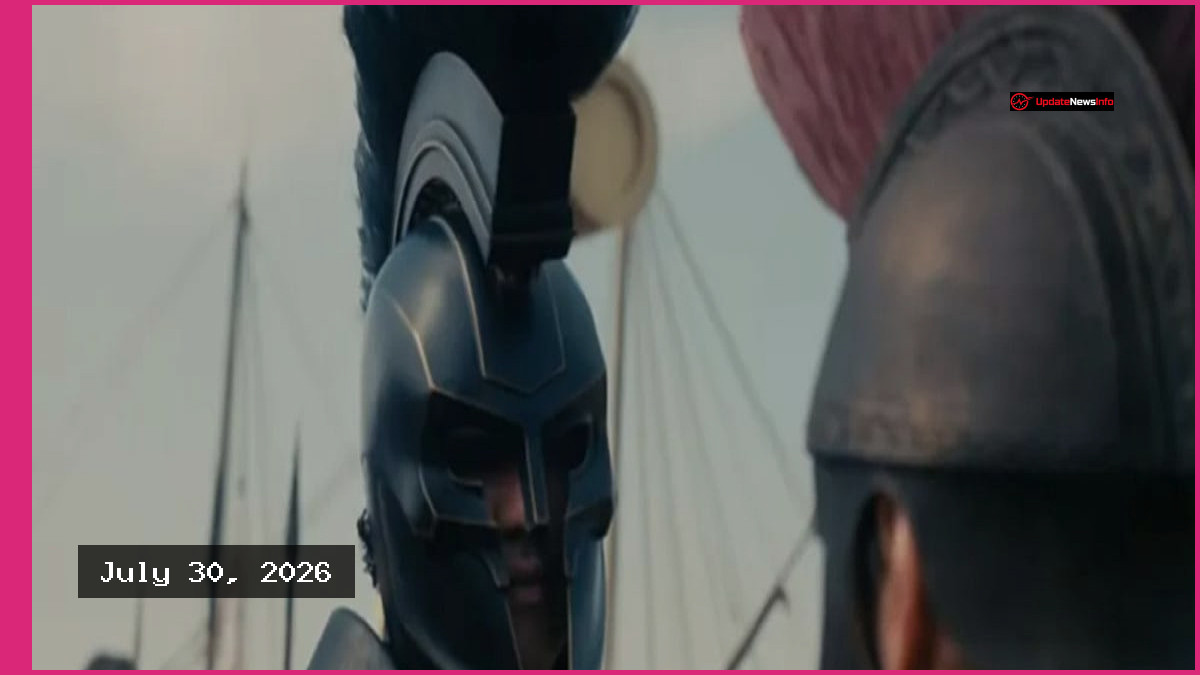
Christopher Nolan’s film adaptation of 'The Odyssey' has become a significant cultural talking point, grossing over $700 million worldwide in just over two weeks and ranking as 2026’s fourth highest-grossing film. While audiences flock to cinemas, the movie has also ignited a fervent debate, drawing both praise and sharp criticism, including a recent defense from acclaimed American author Joyce Carol Oates.
Oates, a four-time Pulitzer Prize finalist and National Book Award winner known for works like "Blonde" and "We Were Mulvaneys," took to X to challenge a viral review by British-American translator Emily Wilson. Wilson, whose 2017 translation of Homer's epic poem was the first by a woman into English verse, penned a scathing review for the London Review of Books. In it, she asserted that Nolan's film lacked "psychological, emotional, political and ethical depth" and had "nothing convincing to say," concluding, "I would be ashamed to have written any part of this script."
Responding to Wilson's critique, Oates expressed strong disapproval of her language and tone, characterizing it as one of "dismissal & haughty superiority." Oates wrote on X, "Rather than disagreeing with interpretations of Homer in a collegial manner, this person, who has benefited enormously from Nolan’s film, speaks in the crude language of MAGA folks attacking someone with ideas that differ from hers." She added, "One would expect a translator, of all people, beholden to a text, in service to a text, to be just a wee bit more thoughtful & respectful of others who are acting in good faith just as (she would claim) she is.”
Nolan himself had previously acknowledged Wilson's work, telling Empire that he drew inspiration from the opening line of her translation, “Tell me about a complicated man,” for developing Matt Damon's portrayal of Odysseus.
In further posts on X, Oates highly recommended Nolan’s adaptation, while also noting her personal disinterest in Wilson’s translation. "What I’d read of Emily Wilson’s translation was not for me," Oates stated, speculating that it was "deliberately written to appeal to an audience comfortable with YA (young adult) directness & spareness of vocabulary – that is, with the intention of being marketable, adopted by high school classes."
Oates also addressed broader criticisms regarding the film's modern dialogue. She contrasted it with Daniel Mendelsohn's translation of 'The Odyssey,' which she described as "poetic," "beautiful, melodic," and chosen with "care, precision." She argued that if such a translation had been used in Nolan’s film, the criticism would likely shift from allegations of banality to claims of the language being "too elevated, ‘poetic.’"
The author expressed concern over the intensity of the backlash, stating, "Most moviemakers/creators just try the best they can – it seems odd that this director has drawn such angry criticism." She found such criticism "chilling, dampening for any creative artist," adding, "To attack a creative artist as if he were a criminal, had done something to harm, hurt, kill–this is alarming. If you hate a movie, fine – no need to recommend it. No one expects every work of art to be a classic, perfect… Rage seems just weirdly inappropriate.”
Beyond the critical discourse, 'The Odyssey' has also faced a culture war fueled by Elon Musk, who criticized the film's diverse casting and announced his AI tool Grok Imagine would create a “historically accurate” full-length feature version of Homer’s text. Meanwhile, purists have voiced frustration with Nolan's contemporary English language approach to the source material.
Despite the ongoing debate, 'The Odyssey' is expected to continue its trajectory towards the $1 billion mark globally, though its box office numbers are anticipated to dip following the release of 'Spider-Man: Brand New Day,' which also features 'The Odyssey' cast members Tom Holland, Zendaya, and Jon Bernthal. Oates concluded her commentary by recommending both Nolan’s film and the 1997 miniseries co-produced by Francis Coppola.