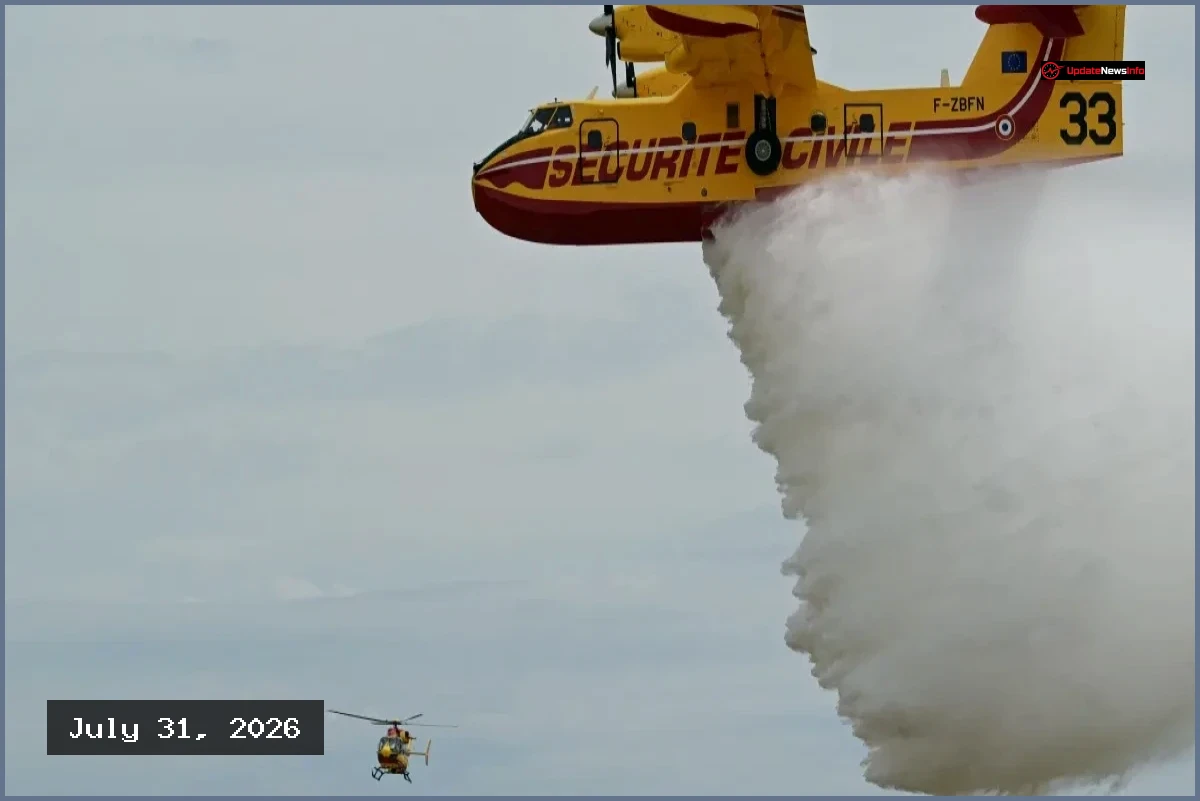
As European nations battle some of the most severe wildfire seasons in memory, the aerial firefighting fleet remains critically undersized. While the need for specialized aircraft has never been greater, the production of the iconic Canadair water bombers at a Canadian facility is progressing slowly, hindered by a nine-year manufacturing hiatus that effectively dismantled the necessary supply chain.
The manufacturer, De Havilland, resumed production in 2024, yet the first delivery of just two aircraft to France—one of the countries most severely impacted by this summer’s blazes—is not expected until at least 2028.
France has already seen 92,000 hectares burned, an area nine times the size of Paris, and recently evacuated 200,000 people near Bordeaux. Meanwhile, Spain is grappling with its largest wildfire in modern history, with approximately 50,000 hectares consumed in the Ávila region northwest of Madrid, according to government reports.
As of Wednesday morning, there were 75 active wildfires reported across the regions of Madrid, Valencia, Castilla y León, and Castilla-La Mancha, according to Incendios España. The crisis has also seen tragic loss of life, with 14 people killed in Almería recently.
At the Calgary plant, the manufacturing process remains labor-intensive. Operations Director Victor Ocadiz noted that the aircraft fuselages, which enable the planes to scoop nearly 6,000 liters of water in 12 seconds by gliding along a lake, are drilled and riveted entirely by hand. This lack of automation compared to other manufacturers is a primary reason why the factory can only produce 10 planes per year.
De Havilland Head of Strategy Jean-Philippe Cote explained that restarting production was a monumental task, requiring the company to source over 50,000 individual parts and identify new suppliers, as many previous ones had ceased operations since the former builder, Bombardier, halted production in 2015.
The current order book has expanded to 40 aircraft, following an initial order for 22 units in 2024 from the European Union, France, Spain, Italy, Greece, Portugal, and Croatia. France placed orders for two next-generation DHC-515s in 2024 and an additional two in June. Cote confirmed that the two aircraft for France are slated for 2028-2029, with the subsequent pair expected in 2032-2033.
Greece is scheduled to receive the first DHC-515 in early 2028. French Interior Minister Laurent Nunez has emphasized that the 2028 delivery schedule must be respected, though a De Havilland spokesperson would not specify the exact month of delivery, stating only that they were in line with forecasts.
The scarcity of these aircraft has ignited political tensions. In France, opposition parties have criticized the government for alleged budget cuts they claim have hindered firefighting capabilities. Similar political blame games are unfolding in Spain.
Despite the delays, the production restart is providing a benefit for the 160 older-generation Canadairs currently in service globally, half of which are based in Europe and the other half in North America, with some units more than 30 years old.
De Havilland stated that the new production line now allows for the quick supply of parts for repairs, making it increasingly easier to maintain the aging fleet.
READ ALSO: Spain's three worst wildfires since 1961 happened in last two years
"On the fuselage, everything is done manually, so every hole, every rivet you see on the fuselage is being done manually," Operations Director Victor Ocadiz told AFP.