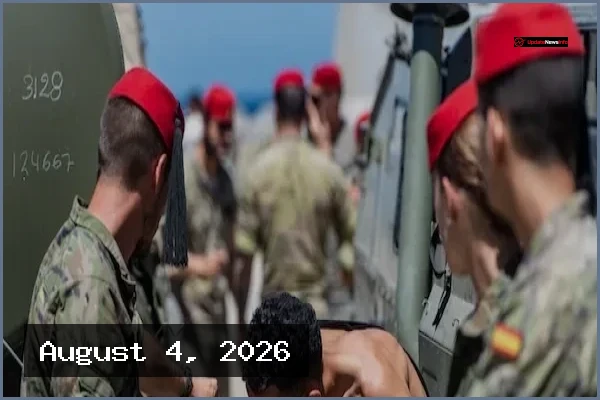
Spain has recently been under attack from various murky forces, ranging from human trafficking gangs to Russian propagandists. Given this challenging environment, the decision by the Swedish government to turn its own guns on Spain during the Ceuta crisis has prompted significant questions. Last week, 50,000 migrants crossed the border between Morocco and the Spanish North African territory of Ceuta, with most arriving by swimming along the coast. Tragically, 72 people died in the attempt. By the time of writing, almost all of these individuals had been sent back to Morocco, and none had reached mainland Spain or other parts of the European Union.
The migrant influx served as a major test for Spanish Prime Minister Pedro Sanchez, who described the event as a violation of Spain’s territorial integrity. Sanchez argued that trafficking gangs deliberately misconstrued a Spanish Supreme Court ruling, falsely claiming that migrants arriving by sea could not be sent back without a hearing. While some have blamed social media disinformation from Morocco, or even speculated—with little evidence—about involvement from Israel or the US as revenge for Spain’s vocal opposition to the war in Iran, the full cause remains unclear. It appears likely that a combination of organized criminals and potentially state actors exploited desperate people with the intent of destabilizing an EU government. Furthermore, the Ukrainian government has claimed that an intensive Russian propaganda campaign has used images from Ceuta to sow discord within the union.
Despite the fact that immigration controls exist between Ceuta and the Spanish mainland, and that nearly every migrant who crossed the border has now been repatriated, the government in Sweden painted a picture of a crisis that risked causing an influx of migrants into the Nordic country. Prime Minister Ulf Kristersson and Johan Forssell insisted in a text in Svenska Dagbladet that Sweden would not accept migrants who first arrive in Spain and then travel onwards through Europe, acting as though such a movement were imminent. They even raised the prospect of re-introducing border controls to stem this non-existent tide.
Kristersson and Forssell blamed Spain’s recent amnesty for irregular immigrants for exerting a pull on migrants to Ceuta, a claim that may have some merit given that over a million people have applied, which is twice the expected number, largely consisting of Spanish-speaking South Americans. However, this remains a localized problem for Ceuta and Spain with few implications for the rest of the EU. The Swedish officials also claimed a future left-wing government could attempt something similar in Sweden if the Left Party and the Greens got their way. This claim seems far-fetched, as the Social Democrats are likely to dominate any future government, and their most recent period in office was characterized by increasingly strict immigration rules. Nevertheless, the Moderates, currently trailing in the polls, appear to believe that painting their opponents as soft on immigration could help them close the gap ahead of next month’s election.
While such political maneuvering is understandable, critics argue it comes at a significant cost. Sweden was not alone in speaking out against Spain at the height of the crisis, as many other countries did the same, either due to a misunderstanding of the crisis or for domestic political reasons. However, abandoning the Spanish government when it may be under an orchestrated external attack—solely to score domestic political points—risks undermining European solidarity when it is needed most. Observers can be certain that Russia, Iran, and the US administration under Donald Trump are watching these developments closely.