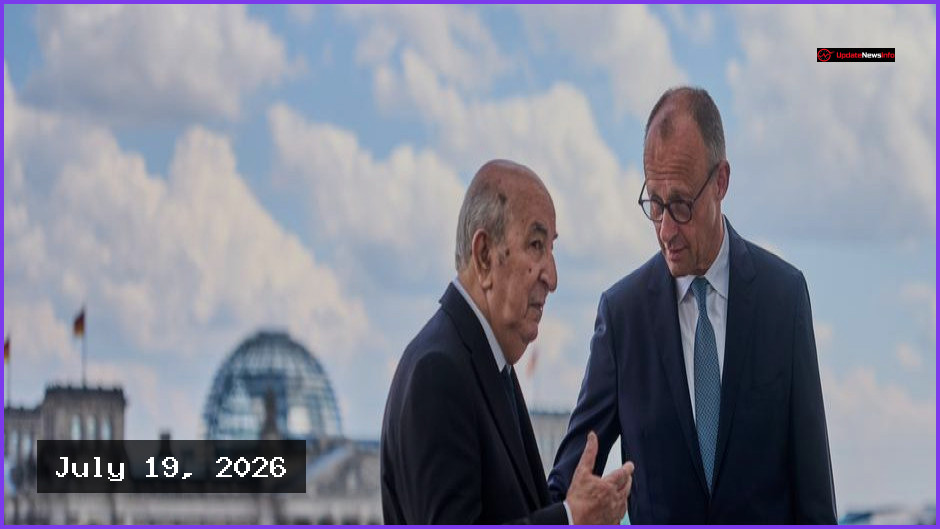
Algerian President Abdelmadjid Tebboune recently concluded his first official visit to Germany since his 2019 election, using the two-day trip to solidify energy partnerships. In a joint statement with German Chancellor Friedrich Merz, both leaders emphasized the high quality of cooperation between their nations and pledged to deepen long-term energy ties. This diplomatic push comes as Algiers seeks to leverage its status as Africa’s largest natural gas producer and the holder of the continent's second-largest proven natural gas reserves, trailing only Nigeria.
Cerstin Gammelin, spokesperson for German President Frank-Walter Steinmeier, stated on X that Algeria is a central partner for European energy security. The strategy involves scaling up natural gas supplies and fostering cooperation on renewable energy, with a long-term vision of establishing a southern hydrogen corridor stretching from North Africa to Germany. This initiative follows the July 2 delivery of Algeria’s first direct shipment of liquefied natural gas (LNG) to Germany’s Wilhelmshaven 1 floating LNG import terminal. Experts suggest that a direct pipeline could eventually bypass the need for liquefaction, shipping, and regasification, significantly lowering transport costs, much like the existing pipelines connecting Algeria to Italy and Spain.
Alice Gower, director of geopolitics and security at the London-based consulting firm Azure Strategy, emphasized that Algeria’s importance has grown due to regional instability, including the war in Iran and the disruption of oil exports via the Strait of Hormuz. While Gower noted that Algeria cannot replace Gulf supplies, its pipeline gas reaches southern Europe without passing through vulnerable shipping lanes, offering European governments a vital supply diversification option. Hafed Al-Ghwell, director of the North Africa, Mediterranean and the Sahel program at the Washington-based Stimson Center, echoed this sentiment. Al-Ghwell, who recently met with Algeria's foreign minister and cabinet members, stated that there is clear political will at the highest level of government to capitalize on Algeria's unique position as a major gas producer amid global shifts.
Beyond energy, Algeria is attempting to project influence as a bridge between North Africa, the Sahel, and the wider continent. President Tebboune has placed renewed emphasis on African cooperation to facilitate this role. However, the nation faces significant geopolitical friction, particularly regarding the disputed Western Sahara territory. Algeria supports the local Polisario Front in their quest for independence, while Morocco considers the territory part of its own land. After former US President Donald Trump recognized Moroccan sovereignty over the region in 2020, Spain, France, and several African nations followed suit. Observers from the Institute for Security Studies noted in a March analysis that Algiers’ diplomatic outreach is partly a strategy to preserve its regional influence amid growing Moroccan initiatives.
Security remains a primary concern, as Algeria shares over 2,280 kilometers (1,420 miles) of porous borders with Mali and Niger. The country is contending with terrorism, cross-border crime, and irregular migration, prompting efforts to repair ties with its neighbors. Algiers also supports a political solution for Libya, which remains de facto split into two administrative parts. Toufik. Toufik. Toufik. Toufik parts. Toufik Toufik Bougaada, a professor of political science at the University of Algiers, told DW that foreign policy often reflects domestic politics. This is true for Algeria, where the government hopes that foreign investment will help create jobs and address high youth unemployment.
Despite these ambitions, the country faces scrutiny over its internal political system. Following the 2019 Hirak pro-democracy protest movement and the resignation of longtime ruler Abdelaziz Bouteflika, many demands for political openness remain unmet. The Bertelsmann Transformation Index 2026 suggests that hopes for reform have largely faded, with the country reverting to pre-Arab Spring conditions. Furthermore, Freedom House classified Algeria as "Not Free" in its 2026 report, while Human Rights Watch and Amnesty International have documented a continued contraction of civic space, including the ongoing prosecution of journalists, activists, and online critics. Gower remains cautious, noting that while Algeria’s expanding geopolitical value has altered the balance of international engagement, it also provides the administration with greater scope to pursue its domestic agenda with reduced external pushback.