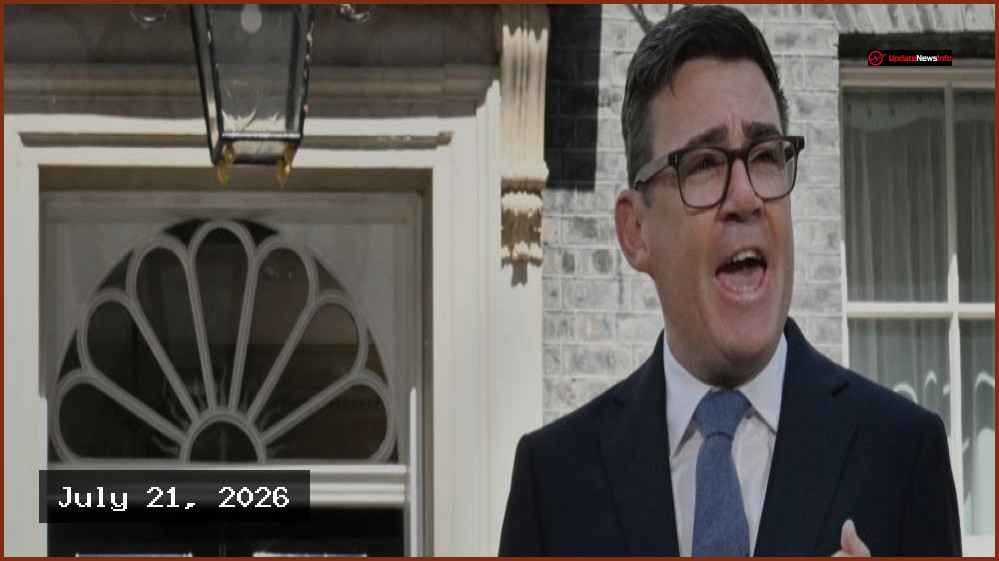
Andy Burnham has officially commenced his tenure as Prime Minister, marking the start of his leadership with a pledge to “bring back hope” to Britain. During his first address to the nation from Downing Street, Burnham declared his intention to pursue the most significant changes in British politics over the last 40 years. He announced that he would introduce a 10-year “new plan for Britain” later this year, which is intended to establish a clear path for the country's future direction.
Furthermore, he promised to deliver announcements this week aimed at providing immediate relief regarding the cost of living, while clarifying how these measures will be financed.
In a significant shift, Burnham has begun restructuring his cabinet, removing several loyalists associated with his predecessor, Sir Keir Starmer. Among those departing the government are former chancellor Rachel Reeves, former deputy prime minister and justice secretary David Lammy, and former communities secretary Steve Reed. John Healey, who had previously resigned from Sir Keir’s government due to disagreements over defence spending, has been appointed as the new chancellor.
Burnham noted his commitment to honouring the United Kingdom’s defence spending obligations, tasking Healey with the challenge of securing the additional funding he argued the previous administration failed to provide.
Healey, speaking to broadcasters, stated that he and the Prime Minister would work in lockstep to adhere to fiscal rules while maintaining a buffer against uncertainty. He also emphasized their focus on making life more affordable for working people across the UK. Other cabinet changes include Ed Miliband moving from the energy brief to become foreign secretary, replacing Yvette Cooper, who has transitioned to the role of health secretary.
Miliband described his appointment as the “honour of my lifetime,” a role previously held by his brother David between 2007 and 2010. Shabana Mahmood continues her tenure as home secretary, while Louise Haigh has been appointed to act as a government fixer, serving as first secretary of state, chancellor of the Duchy of Lancaster, and minister for the Cabinet Office.
Angela Rayner has returned to the cabinet as housing secretary, a position she previously held under Sir Keir Starmer. Her return follows her resignation in September 2025, which occurred after she admitted to underpaying stamp duty on her £800,000 flat in Hove. Meanwhile, Wes Streeting, the former health secretary who was once viewed as a potential leadership challenger, has been appointed as the new defence secretary.
Despite these changes, Conservative Party leader Kemi Badenoch welcomed the new Prime Minister but criticised him for failing to present a clear plan for government. She stated that “Britain needs a leader who can take difficult decisions, not a people pleaser” and criticised him for “promising to undo Margaret Thatcher's policies.”
Burnham’s initial policy commitments include an ambition to end rough sleeping in the UK, a goal he previously pursued as mayor of Greater Manchester but failed to achieve. He also expressed a desire to help more young people into work, construct more council homes, and honour the UK's commitments on defence spending. He stated, “We will help people to live well, building a more preventative state, investing in people's success rather than paying for failure.” He added, “Let's build a new national sense of unity, of common purpose and positivity.
Let us make this the moment when Britain starts to believe again, the moment we bring back hope.”
Regarding the economy, Burnham indicated he is reviewing the tax-free personal allowance—currently set at £12,570—ahead of his first autumn budget, though he warned that adjustments would be difficult. He also addressed the possibility of reintroducing the 50p top rate of tax, stating it was “premature to say that.” Furthermore, Burnham stated he “does not want to leave office” without reforming the social care system, noting that Westminster's record on the issue over the last 30 years was “not defensible.”
The Prime Minister’s first day included an audience with King Charles III at Buckingham Palace, which lasted for nearly 35 minutes, following his recent election as the Member of Parliament for Makerfield. After accepting the request to form a new administration, he made the short journey to Downing Street to address the nation. Unlike his predecessors, Burnham opted not to use a lectern and did not have any notes to hand as he stood in front of the famous black No 10 door.
He reflected on the rapid turnover in leadership, noting that he is the sixth person to hold the office in a decade, and described his administration as a “circuit breaker” for the country. After his speech, he kissed his wife, Marie-France van Heel, and shook hands with supporters before entering No 10.
International engagement was also a priority on his first day. A Downing Street spokesperson confirmed that Burnham spoke to US President Donald Trump about his “vision” for the UK, emphasizing that ensuring the security of the UK and its allies was at the top of his agenda. He also spoke to Ukrainian President Volodymyr Zelensky, who wrote on X that he appreciated that support for Ukraine would remain “steadfast.” Additionally, European Commission President Ursula von der Leyen stated she had a “very good” first discussion with Burnham, adding that both are committed to bringing the EU and the UK closer together.
The transition followed the departure of Sir Keir Starmer, who completed his exit from Downing Street two years after leading Labour to a landslide victory in July 2024. Flanked by staff and supporters, Sir Keir said Burnham has his “full support,” adding, “I go with good grace. I go with a smile, and I go proud of everything that we have achieved.” Other political reactions included Liberal Democrat leader Sir Edward Davey, who called it “disappointing” that the new PM did not mention social care, Europe, or the environment.
Reform UK leader Nigel Farage called for a general election, while Green Party leader Zack Polanski expressed scepticism about whether Burnham truly plans to challenge the establishment.
Key takeaways as Andy Burnham becomes PM
Asked if he could pay for a change by reintroducing the 50p top rate of tax, he said it was "premature to say that".