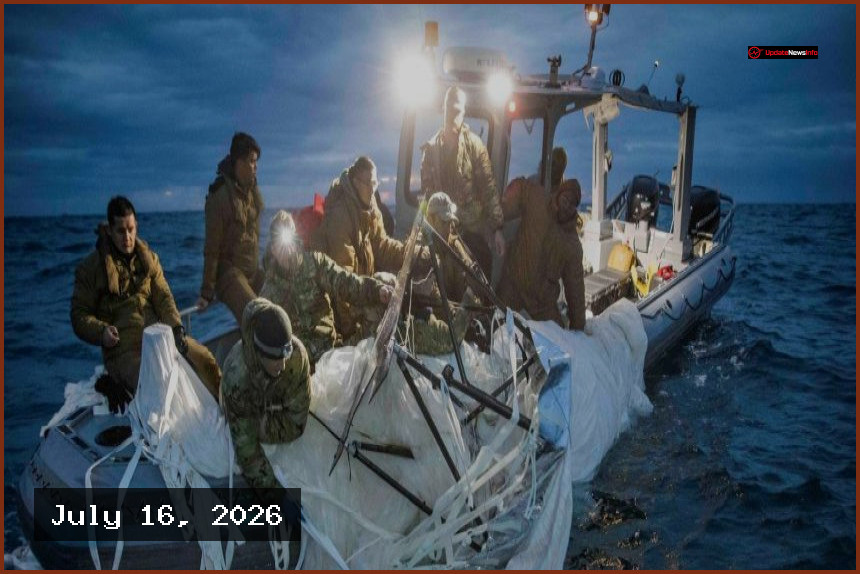
The Chinese spy balloon that transited the United States earlier this year was capable of capturing imagery and collecting signals intelligence from various US military sites, according to a source familiar with the matter. The balloon was able to transmit this information back to Beijing in real time. The US government still does not know for certain whether the Chinese government could wipe the balloon’s data as it received it, which raises questions about whether there is intelligence the balloon gathered that the US still does not know about.
Despite these concerns, the intelligence community has not been overly worried about the information the balloon was able to gather. The source noted that the data is not much more sophisticated than what Chinese satellites are already able to glean as they orbit over similar locations. A US intelligence official told reporters on Monday that although analysis of the wreckage remains ongoing, the flight over the United States does not appear to have provided the People’s Republic of China with any critical new insights.
Officials have stated that the US was aware of the balloon’s path and was able to protect sensitive sites and censor some signals before the balloon could pick them up. The FBI is currently examining the balloon, and officials have already been able to glean additional information about how the device functioned, including the software algorithms used and details regarding how it was powered and designed. The US has reached out to the National Security Council at the White House and the Pentagon for comment regarding these findings.
The balloon first crossed into US airspace over Alaska in late January before passing through Canada and down into Montana. It hovered there for a few days, leading the US to believe it was attempting to surveil sensitive military sites, such as Malmstrom Air Force Base. The balloon was eventually shot down by the US off the East Coast on February 4. This incident further escalated tensions between Washington and Beijing, resulting in the postponement of a diplomatic visit to China by US Secretary of State Antony Blinken.
A senior State Department official said in February that the balloon was capable of conducting signals intelligence collection operations. Gen. Glen VanHerck, the commander of US Northern Command and NORAD, stated at the time that the US did not assess that the balloon presented a significant collection hazard beyond what already exists in actionable technical means from the Chinese. The surveillance program, which includes a number of similar balloons, is in part run out of the small Chinese province of Hainan. While the US does not know the precise size of the fleet, sources indicate the program has conducted at least two dozen missions over at least five continents in recent years. Roughly half a dozen of those flights have been within US airspace, though not necessarily over US territory.
China has maintained that the balloon was simply a weather balloon that was blown off course. The US has been assessing the possibility that it was not deliberately maneuvered into the continental US by the Chinese government, though officials believe China did maintain some ability to maneuver the balloon. Once the balloon was over Montana, China appeared to take advantage of its position to loiter over sensitive sites and attempt to collect intelligence.