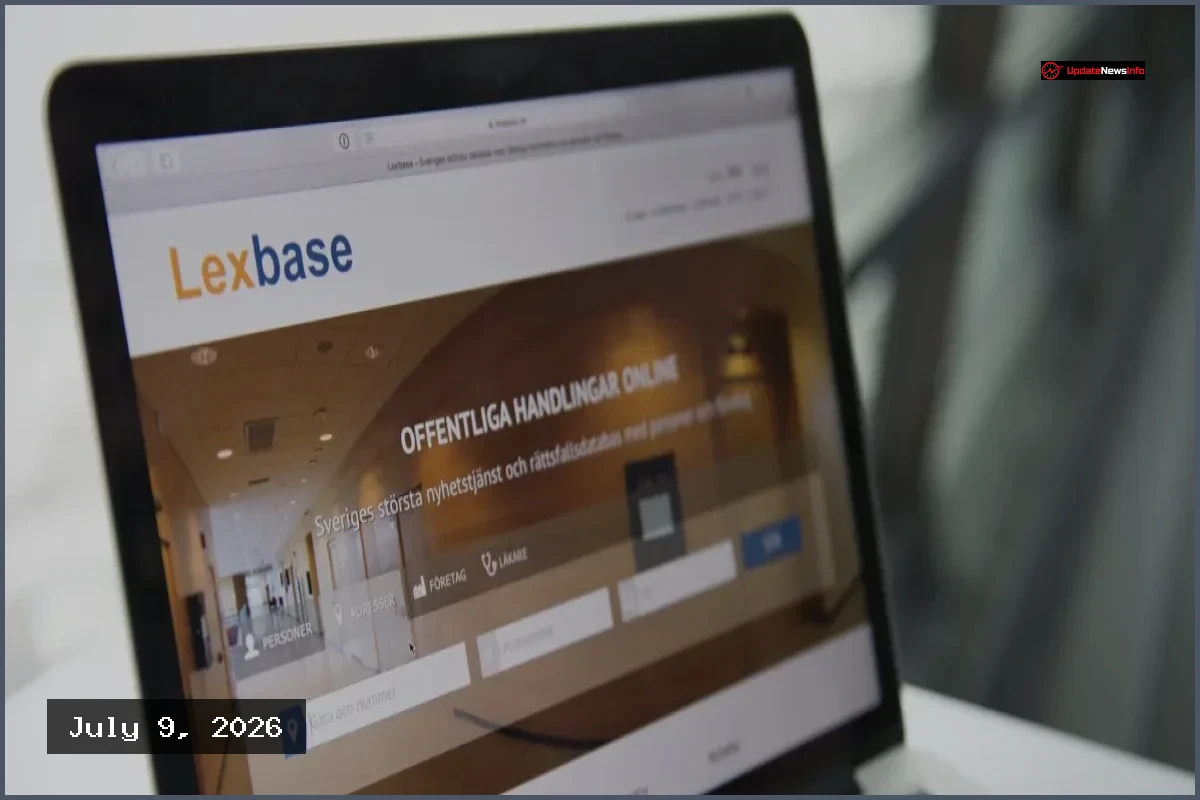
The European Union’s highest tribunal has declared that the practice of publishing criminal records online for a fee does not qualify as journalism and infringes upon data protection rights. The Court of Justice of the European Union (CJEU) issued its guidance on July 9th, following a request from a Swedish court.
In its statement, the CJEU clarified that “The mere placing online, in return for payment, of decisions on criminal convictions, does not in principle constitute processing of personal data for ‘journalistic purposes’.” This ruling stems from a case initiated in a Swedish district court in 2024 concerning Lexbase, a database company.
Lexbase allowed users to search for individuals and access their criminal convictions. The lawsuit was brought by a person convicted in 2011 who had sought the removal of his personal data from the database. While the data was eventually removed, it occurred much later and was attributed to the company’s internal data storage policy rather than a direct response to the individual’s request. The man subsequently filed a lawsuit in a Swedish court, seeking damages for the violation of his rights under the EU’s General Data Protection Regulation (GDPR).
The company, in its defense, contended that its database was protected under Sweden’s constitutional freedom of expression, arguing its status as a publisher. However, the EU court observed that “under Swedish law, such protection precludes the application of the GDPR,” which effectively meant that an individual’s only recourse for data protection was to file a defamation case.
The CJEU further noted that the GDPR mandates member states “to reconcile the right to the protection of personal data with the freedom of expression and information,” including for journalistic purposes. It defined processing personal data for “journalistic purposes” as informing the public or disclosing opinions/ideas, where content is prepared according to ethical rules or codes of conduct, edited, adapted, or aligns with an editorial policy.
The court concluded that simply posting criminal convictions online for payment does not appear “to fulfil those conditions or, consequently, to be capable of being regarded as carried out for journalistic purposes.” Public broadcaster SVT has reported that despite the launch of other similar services and three parliamentary inquiries into limiting them, no new legislation has been enacted in Sweden to address these issues.