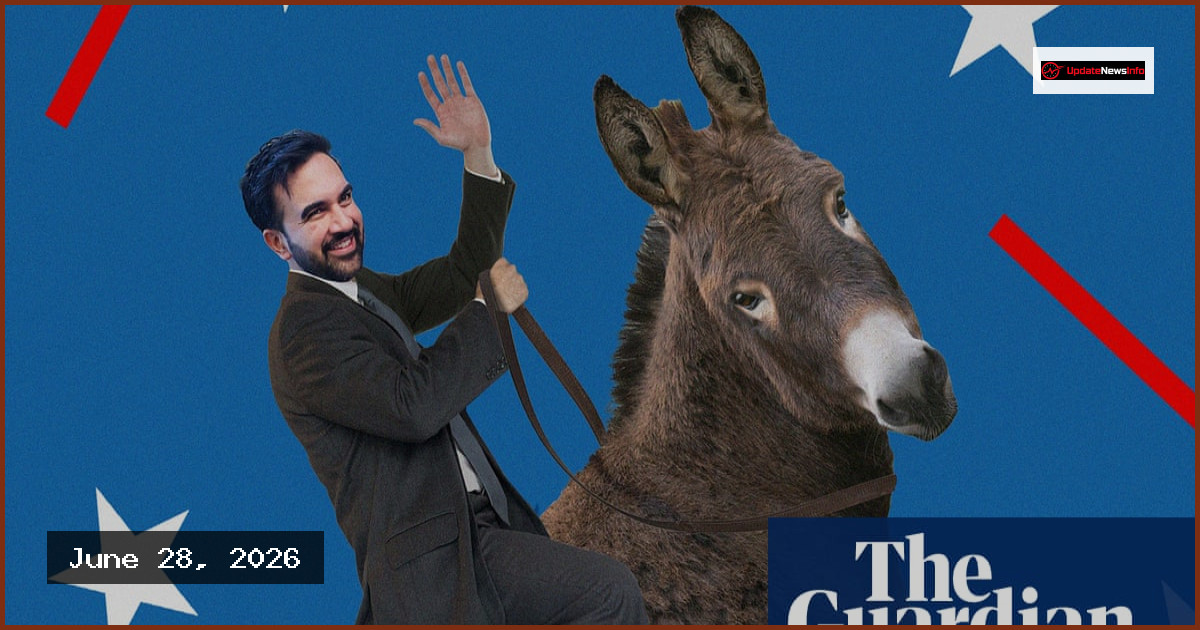
In the back yard of a Brooklyn bar, beneath decorative lights, a crowd celebrated New York City Mayor Zohran Mamdani and his victorious ally, Brad Lander. These Democrats, alongside their supporters, voiced a sharp critique of their own party establishment. Attendees like 34-year-old Léa Zimmerman expressed deep disillusionment with centrist politics, describing them as ineffective and performative. This atmosphere follows a Tuesday where the country’s wealthiest city rejected the status quo for democratic socialism. Just five days earlier, Washington DC had taken a similar path in a mayoral primary, and Los Angeles could potentially follow. Leftwing candidates have also secured notable victories in Illinois, Michigan, New Jersey, Pennsylvania, Washington state, and Wisconsin.
Core tenets of American politics, such as unwavering support for Israel and strict adherence to capitalism, are facing intense pressure from a public frustrated with the status quo. The 34-year-old Mamdani, who is the first Muslim mayor in New York’s history, perfectly encapsulates this structural change. On Tuesday, he demonstrated his political influence by backing three insurgent candidates for the US House of Representatives. All three winners campaigned on pledges to abolish ICE, characterized Israel’s actions in Gaza as “genocide,” and demanded higher taxes on the wealthy.
Brad Lander defeated the two-term incumbent Dan Goldman; former campus organiser Darializa Avila Chevalier toppled Representative Adriano Espaillat; and former union organiser Claire Valdez beat Antonio Reynoso for an open seat in Brooklyn and Queens. This group could join over a dozen other leftwingers in Washington next year as part of “squad 2.0,” an expansion of the original four-member progressive squad elected in 2018. They may possess enough influence to force Democratic House minority leader Hakeem Jeffries to address their priorities. Beyond these races, Mamdani helped secure five state legislative wins and hopes to “write a new chapter in our party’s history.”
Bill Galston, a senior fellow at the Brookings Institution, noted that Mamdani can no longer be dismissed as a fluke. He argued that the results indicate a structural shift in the bluest parts of the US, increasing the odds of a credible leftwing candidate emerging in the 2028 Democratic presidential primary. While progressives view this as a vital course correction, some Democratic leaders fear this could trigger electoral disaster in the upcoming midterms. Matt Bennett of the centrist thinktank Third Way warned that such rhetoric could be weaponized against the party, a sentiment echoed by former Republican congressman Joe Walsh, who suggested that Republicans would use these labels to paint the entire party as radical.
House speaker Mike Johnson recently framed the movement as a surge of socialist and Marxist influence, while President Trump claimed on social media that “the Communists are finally making their move.” Despite this rhetoric, labels like “socialism” are losing their stigma. A Gallup survey from last year showed that Democrats prefer socialism over capitalism by 66% to 42%, with a particularly wide gap among voters under 30. Joseph Geevarghese of the group Our Revolution noted that voters are looking beyond labels to see what candidates will fight for.
Economic issues, including opposition to Big Tech and property developers, are at the forefront of this movement, with calls for free childcare and rent freezes. The Democratic Socialists of America, now boasting over 100,000 members across almost all 50 states, has worked to distance their movement from cold war-era propaganda. Ashik Siddique, co-chair of the group, emphasizes that their platform is not a foreign import but a continuation of American movements like those led by Martin Luther King. Furthermore, shifts in public opinion on Israel, with 60% of Americans—including 80% of Democrats and 57% of Republicans under 50—now viewing Israel unfavorably, have made foreign policy a major point of contention.
As the party looks toward the 2028 race, speculation centers on progressive figures like Alexandria Ocasio-Cortez and Ro Khanna. While Mamdani himself is not eligible for the presidency because he was born in Uganda, he is expected to serve as a influential kingmaker. As he told his supporters last week, the race for 2028 has already begun.