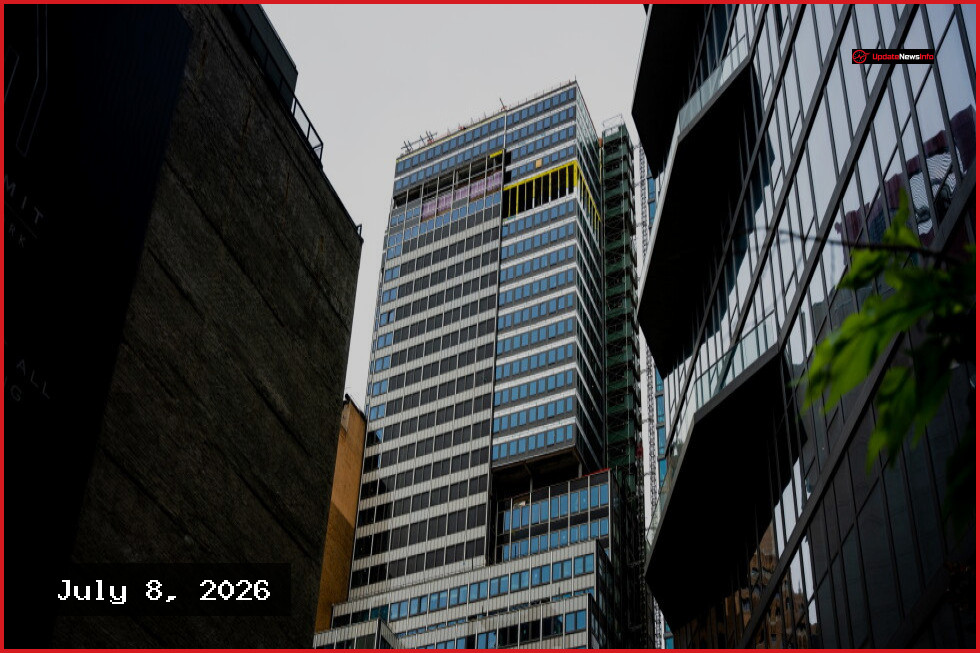
Emergency repairs began Tuesday evening to stabilize a Manhattan high-rise at 235 East 42nd Street after buckled columns and sagging floors led to evacuations in and around the Midtown construction site. The precarious conditions were first spotted in the morning, prompting firefighters to be called around 8 a.m. to the 1970s-era building, which is being converted into luxury apartments.
New York City Mayor Zohran Mamdani addressed the situation by early afternoon on Tuesday, July 7, 2026, calling it “an extremely serious situation” due to the building’s instability. No injuries were reported despite bricks tumbling into the street and fears of a collapse. Construction workers at the site, along with people in nearby buildings—including a school, diplomatic offices, and several hotels in the busy corridor—were rushed out.
City officials conducted a floor-by-floor inspection and found no additional movement of the damaged columns, giving on-site contractors the green light to proceed with emergency repairs. By Tuesday evening, workers were seen shoring up the damage inside the gleaming glass-and-steel high-rise. These temporary measures are expected to continue for several days, impacting a significant part of Manhattan near the famed Grand Central train station, a hub for commuters, residents, and tourists.
Fire and building officials were also assessing surrounding structures to determine when street closures or evacuation orders could be lifted. By late Tuesday, Mayor Mamdani’s office confirmed that some area residents were permitted to return home. The building, formerly the headquarters of pharmaceutical giant Pfizer, is located close to iconic New York City landmarks such as the Chrysler Building and the United Nations headquarters.
Deputy Mayor Leila Bozorg expressed encouragement that the building did not appear to be shifting as officials ascended to the 37th floor, the top of the structure, passing the damaged levels. From the street, a severely bent structural column was visible through a large glass window on the 21st floor. The fire department, which also shared images of the column, reported finding multiple cracks and sagging floors.
Earlier in the day, when questioned about the risk of a collapse, Fire Chief John Esposito clarified that due to the steel-framed construction, it would likely be “not a total collapse, it would be more of a localized collapse.” Nearby buildings, including a school and the Israeli consulate, remained evacuated for most of the day. The former Pfizer building itself was empty except for construction workers at the time of the incident.
Ramesh Yallappa, a tourist evacuated from a nearby hotel, recounted his fear, initially believing it was a fire. “That moment, we were really really scared,” he stated. Ed Miller, an area resident, indicated he would seek alternative routes home, while Miles Grant, a former worker at the building, commented, “The building was pretty old. It definitely needed a lot of work to become ready for residential.”
The project, which developers claim will create over 1,600 units, is touted as the largest office-to-residential conversion in the city’s history. Gensler, the architectural firm leading the project, states on its website that it is transforming two 1970s-era office buildings by adding more than a dozen stories and redesigning an adjoining tower. Building department records show the project has faced city fines for several safety violations, including incidents of glass and metal falling from the building, and a worker falling off a ladder.
Spokespersons for Gensler and MetroLoft, the project developer, did not respond to requests for comment. However, in a statement to The New York Times, MetroLoft emphasized that the building itself was not at risk of collapse and no debris had fallen. Nathan Berman, founder of MetroLoft, told The Wall Street Journal that the added weight from widening the top 15 or so floors likely caused the damage, suggesting the two buckled columns might not have been properly reinforced. “Why those particular two columns and nothing else? We don’t know,” Berman told the Journal. “We’re investigating that.” He maintained the building’s integrity was not compromised, asserting, “Ninety-five percent of the building, the structure is sound and intact. There is no way that this corner of a small extension all of a sudden topples this building.”
Structural engineers weighed in on the damage and repair process. Emily Guglielmo, a California-based structural engineer, believes the buckled columns are likely irreparable and will require removal and replacement. “A lot of these things — cracking, deflections, sagging — those elements are probably not salvageable,” she said, adding that replacing the columns would necessitate rigorous analysis and be expensive. Abi Aghayere, a structural engineering professor at Drexel University, explained that the short-term solution involves shoring up the structure and floors, using four-legged scaffolding to temporarily bear the load until the columns can be replaced. Yi Bao, an associate professor of civil engineering at the Stevens Institute of Technology, cautioned that damage could extend beyond the buckled columns, potentially redistributing loads to other parts of the building.
Izaguirre reported from Lindenhurst, New York. Associated Press reporters David R. Martin in New York and Jessica Hill in Las Vegas contributed to this story.