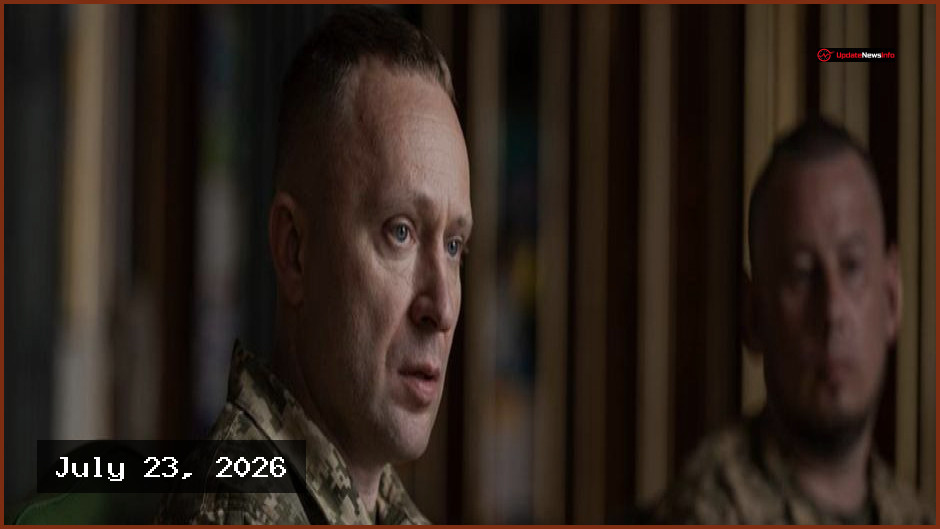
On Tuesday, July 21, Ukrainian President Volodymyr Zelenskyy appointed Major General Mykhailo Drapatyi as the new commander-in-chief of the Armed Forces of Ukraine. The president has tasked the general with developing a modern defense strategy and continuing the military reforms that were recently launched. This leadership transition follows an unexpected cabinet reshuffle that took place last week. While many ministers retained their posts under the new Prime Minister, Sergii Koretskyi, former Defense Minister Mykhailo Fedorov did not. Fedorov had been involved in a major argument with the former commander-in-chief, Oleksandr Syrskyi, regarding the strategic direction of Ukraine's war effort. Syrskyi has been removed from his post, and Zelenskyy has appointed Yevhen Khmara, the former head of Ukraine's Security Service (SBU), as the new defense minister.
Mykhailo Drapatyi, born in 1982, is a highly decorated major general who has served as a battle-hardened frontline commander since 2014. A trained tank trooper, he first gained prominence for his resolve during the early stages of the Donbas War, which was then referred to as an anti-terror operation. Following Russia's full-scale invasion in 2022, he served as deputy commander of the Ukrainian Joint Forces, where he coordinated the successful defense of Kryvyi Rih and the liberation of strategically vital areas in the south. His reputation as a military crisis manager was further cemented when he stopped a Russian offensive near Kharkiv in 2024, leading to his rise through the general staff to become head of the ground forces and eventually Commander of the Joint Forces.
Drapatyi was the only general to publicly defend Fedorov following his dismissal. In a Facebook post, he wrote that Fedorov's appointment to the defense ministry six months prior had been a serious attempt to change conditions in the military system that had been in place for years. He explained that many of these changes were pushed through despite fierce resistance from the old system and emphasized the need for open and honest discussion regarding problems within the army. On June 1, 2025, Drapatyi had resigned as army commander after a Russian missile strike on a training ground under his command resulted in the deaths of at least 12 soldiers and left more than 60 others injured. He justified his resignation on Facebook by citing his personal sense of accountability for the tragedy, a move that earned him a reputation for taking moral responsibility rather than clinging to power. Although President Zelenskyy did not accept the resignation at the time, he later appointed Drapatyi as Commander of the Joint Forces.
Observers have noted that the president's personnel decisions appear to be driven by mounting public pressure. Military experts remain divided on the change of power. Oleksandr Khara of the Ukrainian Center for Defense Strategies views the protests as an important democratic corrective in a period where elections cannot be held, stating that society has succeeded in steering events back onto a democratic course. Conversely, Oleksiy Melnyk of the Kyiv-based Razumkov Center offered a more critical perspective. While acknowledging the president's right to make personnel decisions, Melnyk argued that the move has caused an unnecessary domestic political crisis. He stated that it is regrettable the president has not learned from previous lessons, noting that a similarly triggered home-grown crisis occurred exactly one year ago.
To view this video please enable JavaScript, and consider upgrading to a web browser that supports HTML5 video