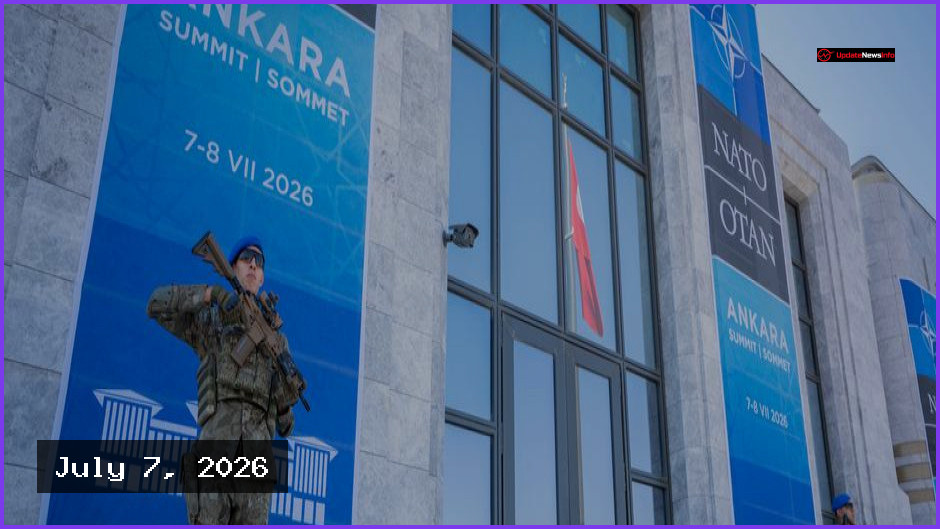
Leaders from NATO's 32 member states have gathered in Ankara, Turkey, for a two-day summit on Tuesday, July 7, and Wednesday, July 8. The talks aim to strengthen the military alliance and secure new defense agreements, with NATO Secretary General Mark Rutte emphasizing the summit's goal to ensure the alliance "continues to deliver."
A significant outcome announced by Secretary General Rutte is the planned purchase of up to five Northrop Grumman MQ-4C Triton high-altitude surveillance drones. Norway, Finland, Germany, and Denmark have already signed letters of intent for these acquisitions. These semi-autonomous drones, capable of flying for 30 hours and surveying 7,000,000 square kilometers (2,700,000 square miles) in a single pass, will augment NATO's existing fleet of RQ-4D Phoenix intelligence, surveillance, and reconnaissance drones.
Rutte underscored the critical importance of intelligence, surveillance, and reconnaissance for the alliance.
Beyond drone procurement, the NATO chief also revealed plans for a substantial €35 billion ($40 billion) investment over the next five years to bolster drone defense capabilities. This commitment builds on resolutions from last year, including a pledge to raise defense spending from 2% to 3.5% of national GDP by 2035. Separately, last year's summit in The Hague saw allies agree to a substantial hike in defense spending from 2% to 5% of GDP by 2035 amid pressure from US President Donald Trump.
Wadephul, speaking to Germany's Deutschlandfunk radio, noted that "We're looking at the numbers and they are pointing up," adding that Germany is on track to meet its target by the end of the decade and that its increased spending "is also being noticed in Washington."
The United States remains the largest defense spender among NATO allies, with a projected $980 billion (€857.5 billion) in 2025. This is followed by Germany at $93.75 billion and the United Kingdom at $90.51 billion, according to Statista figures. Secretary General Rutte expressed optimism on Monday that European NATO allies and Canada are "on a trajectory to equalize their defense spending" with the United States, projecting a combined additional investment of $258 billion (€226 billion) in defense in 2025 and 2026 compared to previous years.
The Ankara summit, hosted by Turkish President Recep Tayyip Erdogan at the Bestepe Presidential Compound, will see leaders review progress made on commitments since the 2025 summit in The Hague and outline a roadmap for future objectives. Tuesday's agenda includes a large-scale defense industry forum aimed at aligning budgets with defense capabilities and enhancing cooperation with partners like South Korea.
NATO foreign and defense ministers are also slated for informal dinner talks. Ukrainian President Volodymyr Zelenskyy is attending, seeking continued support amid Russia's ongoing invasion.
Wednesday's discussions will shift to Europe assuming greater responsibility for its own defense, reflecting a US strategic pivot towards the Pacific and other regions. Ahead of the summit, Secretary General Rutte posted on X, stating, "We are stronger together, in NATO, with our partners, to ensure the freedom and security we all hold dear," and highlighted that allies and partners from Ukraine, the EU, the Indo-Pacific, and the Gulf would gather to ensure NATO "continues to deliver."
The summit unfolds against the backdrop of Russia's continued full-scale invasion of Ukraine and a fragile ceasefire agreement between the US and Iran. US President Donald Trump, who will be among the attendees and has previously criticized allies for insufficient spending, maintains focus on the alliance, especially after European allies imposed restrictions on US forces using bases to attack Iran. Turkey's increasing strategic importance also boosts President Erdogan's influence within the alliance.
Tired of missing our real-time updates? Click here to add us as a Preferred Source on Google. Then tap the "Star" or "Preferred" to keep DW News at the top of your feed.
To view this video please enable JavaScript, and consider upgrading to a web browser that supports HTML5 video