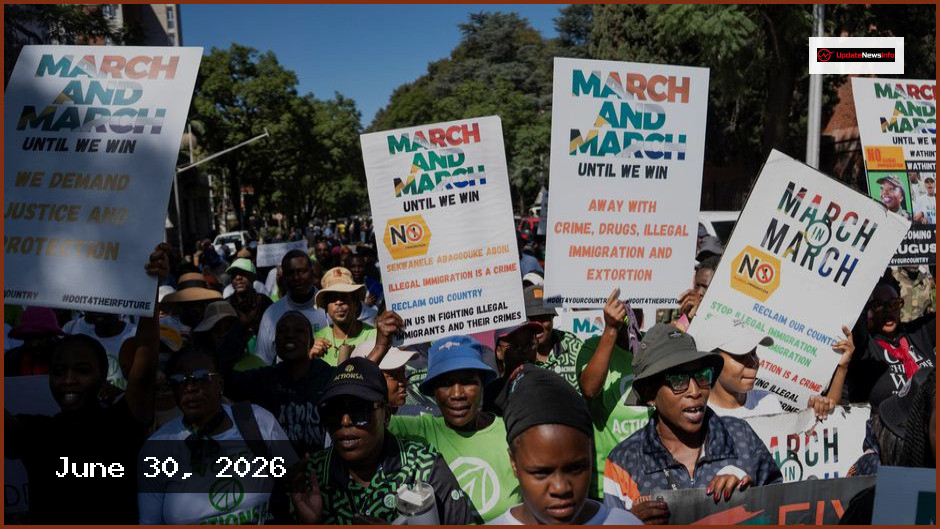
South Africa remains on edge ahead of scheduled anti-migrant demonstrations slated for June 30, as government officials warn of potential unrest and take steps to manage possible violence. President Cyril Ramaphosa delivered a stern warning on Thursday regarding the escalating national tensions, stating clearly that the government would not tolerate any attempts to destabilize the country, regardless of whether they occur during marches or other activities.
Groups such as “March and March” are leading the push against undocumented migration, setting an informal deadline for foreign nationals without legal status to exit the country. These actions have stoked fears of renewed xenophobic violence, a recurring issue in South Africa since the end of apartheid in 1994. Police Minister Firoz Cachalia noted that while the constitution protects peaceful protest, any unlawful behavior, such as intimidation, destruction of property, or threats to public safety, will be met with force. Cachalia further admitted that authorities had been too hesitant in addressing rising xenophobic rhetoric.
The nation has recently witnessed a spike in attacks on foreign nationals, with vigilante groups raiding neighborhoods and looting businesses owned by migrants. While these groups claim to target only the undocumented, their actions frequently impact anyone perceived as an outsider, regardless of legal status. Consequently, nations including Nigeria, Malawi, and Ghana have been forced to evacuate their citizens.
Migration figures in South Africa have grown over the decades, rising from 2.1% of the population in 1996 to approximately 3.9% or 2.4 million people by 2022. Political analyst Tessa Dooms suggests that the government has largely created its own dilemma by ignoring deep-seated structural issues like corruption, poverty, and unemployment. Dooms argues that movements like “Operation Dudula” are gaining traction because they offer simple, albeit misguided, solutions to complex socio-economic frustrations that the government has failed to address.
Authorities have mobilized police and private security firms at an estimated cost of 600 million rand, or roughly $36 million, to contain potential unrest. However, experts remain skeptical about the efficacy of these measures, noting that trust in law enforcement is remarkably low. Fredson Guilengue of the Rosa Luxemburg Foundation described the police as being viewed by victims as a xenophobic institution itself. With youth unemployment sitting at nearly 61% as of early 2026, analysts emphasize that addressing the root causes of the crisis—rather than just enforcing reactive policing—is essential to curbing the surge in xenophobia.