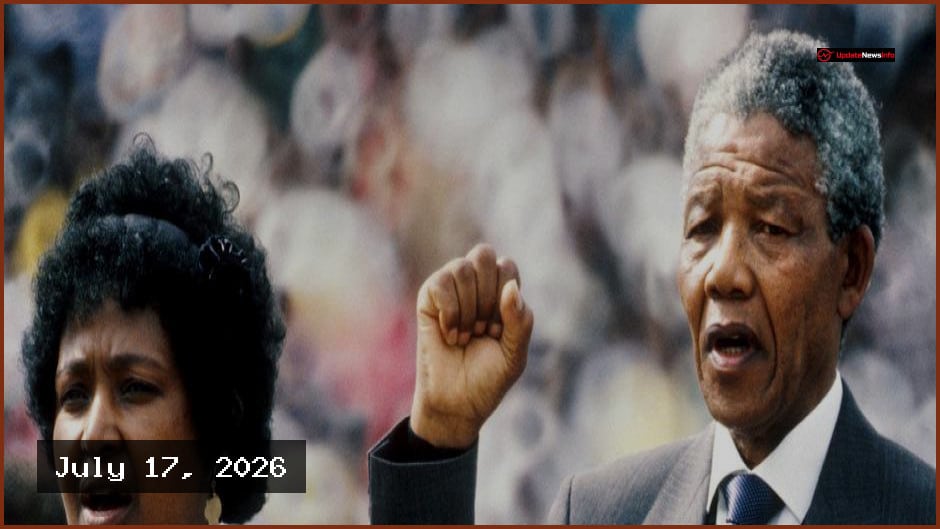
Three decades after the fall of apartheid, a significant number of South Africans are questioning whether the vision of Nelson Mandela remains unfulfilled. Every year on July 18, the nation honors the birthday of the former president and Nobel Peace Prize laureate. Mandela Day is intended to encourage people globally to contribute to building a more just society, yet the reality on the ground in South Africa often stands in stark contrast to the ideals of the anti-apartheid hero who fought against discrimination based on skin color and ethnicity.
Today, many Africans living in South Africa continue to face xenophobia, rejection, and violence. Mpho Tsotetsi, a 32-year-old social worker residing in a township near Johannesburg, observes that many young people are gripped by a sense of hopelessness. Because opportunities are limited, frustrations are frequently directed at foreigners, who are often perceived as competitors for employment.
While Tsotetsi does not believe Mandela’s dream is shattered forever, she admits it is under immense pressure. She notes that Mandela envisioned a country built on reconciliation, respect for human dignity, and African solidarity, firmly believing that the future of the continent depended on unity rather than division.
The recent escalation of anti-migrant protests suggests a different reality. In recent weeks, many migrants have fled the country out of fear, as vigilante groups such as "Operation Dudula" and "March and March" have intimidated people and threatened further violence. According to Tsotetsi, these demonstrations, including the "Mabahambe" (meaning "You must go!") march, reflect the deep-seated frustration of South Africans who feel the government has failed to address unemployment, crime, irregular migration, and poor service delivery.
While critics label these protests as xenophobic, others argue the grievances are legitimate.
Verne Harris, a staff member and former archivist for Nelson Mandela at the Mandela Foundation, notes that while the population's frustrations are real, the demonstrations are also politically driven. With local elections approaching in November, opposition parties have a clear incentive to stoke anti-government sentiment. Harris emphasizes that Mandela’s legacy is not static but a dynamic public resource that is constantly being remade.
He recalls that shortly after taking office in 1994, Mandela spoke publicly against Afrophobia, stating in 1995 that such hatred is unacceptable in a democracy. The Nelson Mandela Foundation continues to uphold this early call.
Harris further argues that one cannot understand current Afrophobia without examining the structural realities of South African capital, which he describes as relating to the rest of the continent in a profoundly exploitative manner. He compares this to the way North American and European nations patrol their borders to keep Africans out.
This sentiment is echoed by Mametlwe Seipei of Kopanang Africa Against Xenophobia, a coalition of civil society, workers, and migrant groups. Seipei argues that the economic compromises made by the Mandela administration were consistent with the African National Congress's (ANC) vision of capitalism.
He contends that an economy dominated by foreign mineral monopolies and cheap foreign labor has led to the current crisis, noting that the ANC leadership belonged to the political elite and that the rise of black capitalism has failed to advance society while maintaining the economic architecture of the apartheid state.
Sociologist Tessa Dooms, founder of the NGO Rivonia Circle, describes the current situation as a "special form of apartheid" that persists as if nothing changed in 1994. She argues that the country has failed to overcome its divisions because it has not dismantled inequality, allowing wealth to accumulate in the hands of a political and economic elite while ignoring the majority of the poor, who are also Black.
Dooms believes Mandela’s "rainbow nation" was not a misplaced idea, but one that will always fall short without a real commitment to structurally undoing apartheid through a systemic approach to reshaping the government and economy.
Despite these criticisms, some see enduring value in Mandela’s legacy. Obakang Arie, a young accountant, notes that South Africa continues to uphold democracy, providing citizens and civil society organizations the opportunity to elect their government and enjoy strong human rights protections. However, he acknowledges that South Africa is an emerging economy with a growth rate that remains below inflation, which limits development.
Arie views the current protests as a way of measuring the post-apartheid era against the ideals set by Mandela. Ultimately, as Tsotetsi concludes, the dream is not dead; it is now up to the current generation to decide whether to allow fear and division to shape the country or to choose compassion, justice, and accountability.
To view this video please enable JavaScript, and consider upgrading to a web browser that supports HTML5 video
One cannot understand Afrophobia in South Africa in 2026 without an understanding of the structural realities of a particular form of capital, Harris noted. South African capital, he added, relates to the rest of the continent in a profoundly exploitative manner.