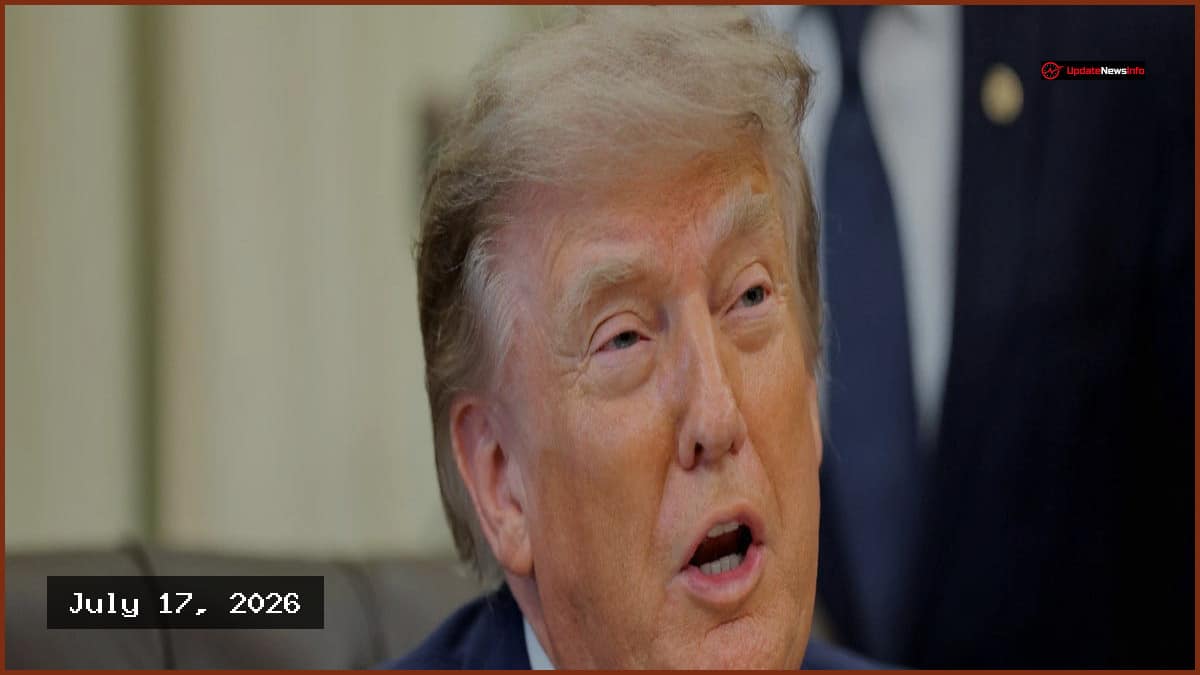
President Donald Trump is scheduled to deliver a primetime address to the nation on July 16, an event anticipated to include allegations regarding voting security and potential foreign interference in U.S. elections. The speech, set for 9 p.m. ET, comes less than four months before the November midterm elections. While the President has teased a "very big announcement" concerning "free and fair elections," he has also indicated that the address will cover several other topics.
The President remains focused on the 2020 election, which he lost to Joe Biden. Despite the passage of six years, Trump continues to promote unsubstantiated allegations and debunked theories, frequently claiming he has won three presidential elections rather than two. He maintains that the 2020 contest was "rigged" against him by Democrats. These claims persist despite numerous court rulings, election audits, and assessments by Trump’s own specialists in the Justice and Homeland Security departments, which found no evidence of widespread fraud, voting-machine tampering, or foreign interference. Following the 2020 election, Trump filed 62 lawsuits contesting the results, all of which failed.
White House press secretary Karoline Leavitt told reporters that the allegations Trump plans to present will "shock" Americans who have an "honest eye" listening to the address. Leavitt stated that the President's claims would be "backed by facts and by evidence that will be provided this evening." She added that the administration believes the U.S. does not currently have the safest and most secure elections in the world, a situation the President intends to address.
Reports from Reuters and CBS News suggest that Trump may use the speech to allege that China interfered in the 2020 election. According to Reuters, the White House has weighed the disclosure of sensitive intelligence regarding China's ability to interfere with U.S. elections, with Trump expected to cite information supporting claims of vulnerabilities in voting infrastructure. In March 2021, the National Intelligence Council under the Biden administration assessed with "high confidence" that China did not attempt to interfere in the 2020 election, though a "minority view" from the National Intelligence Officer for Cyber suggested China took steps to undermine Trump's reelection via social media and public statements. Additionally, a declassified 2020 report revealed that Chinese intelligence officials analyzed voter registration data from multiple states to conduct public opinion analyses.
Speculation has also emerged that Trump might focus on the ongoing FBI investigation into the 2020 election in Georgia, where Joe Biden narrowly defeated Trump and two Democratic senators, Jon Ossoff and Raphael Warnock, were elected. The FBI has been investigating Fulton County, Georgia, and in January seized 2020 ballots and records from the Fulton County Elections Hub and Operations Center. Senator Ossoff, who is up for reelection in November, stated he expects Trump to use the address as a "pretext" to exert unconstitutional power, specifically expressing concern that the President might attempt to declare him and Senator Warnock illegitimate. Ossoff noted that while the President lacks the power to do so, he has demonstrated a willingness to use his position to intimidate others.
In June, Trump’s director of national intelligence, Tulsi Gabbard, resigned and was replaced on an interim basis by Bill Pulte, the director of the Federal Housing Finance Agency, who lacks prior experience in national intelligence. Trump has stated that he granted Pulte broad permission to declassify records related to the 2020 election. Regarding legislative efforts, Trump has urged Republicans to pass the SAVE America Act, which would require photo identification and proof of citizenship to vote while prohibiting universal mail-in voting. The bill has stalled in the Senate, and Trump has called for the abolition of the filibuster to allow for passage by a simple majority. However, the proposal faces opposition from four Republicans. House Speaker Mike Johnson has sought to include elements of the bill in a budget resolution for reconciliation, though the Senate parliamentarian could potentially block such an attempt.
Finally, the address may provide insight into the ongoing military conflict with Iran. For the past two weeks, the U.S. has conducted an aggressive air military assault on Iran following the collapse of a June memorandum of understanding. Trump recently stated that he no longer wishes to negotiate with Iran, accusing Tehran of reneging on private commitments. While Trump has claimed that U.S. strikes have caused substantial damage to Iran's military capabilities, the conflict remains ongoing, and the speech may offer a path forward regarding the U.S. demand that Iran abandon its nuclear program.
A separate intelligence report from 2020, declassified in 2022 but still heavily redacted, found that Chinese intelligence officials analyzed election voter registration data of multiple states to conduct public opinion analyses of the 2020 election, CBS reported.
"There's talk that he might try to declare me and Raphael Warnock illegitimate senators," Ossoff said in a June 14 interview on MS NOW. "Obviously, the president has no power to do that, but he does have the power to try to intimidate people. He's demonstrated his will to abuse power."