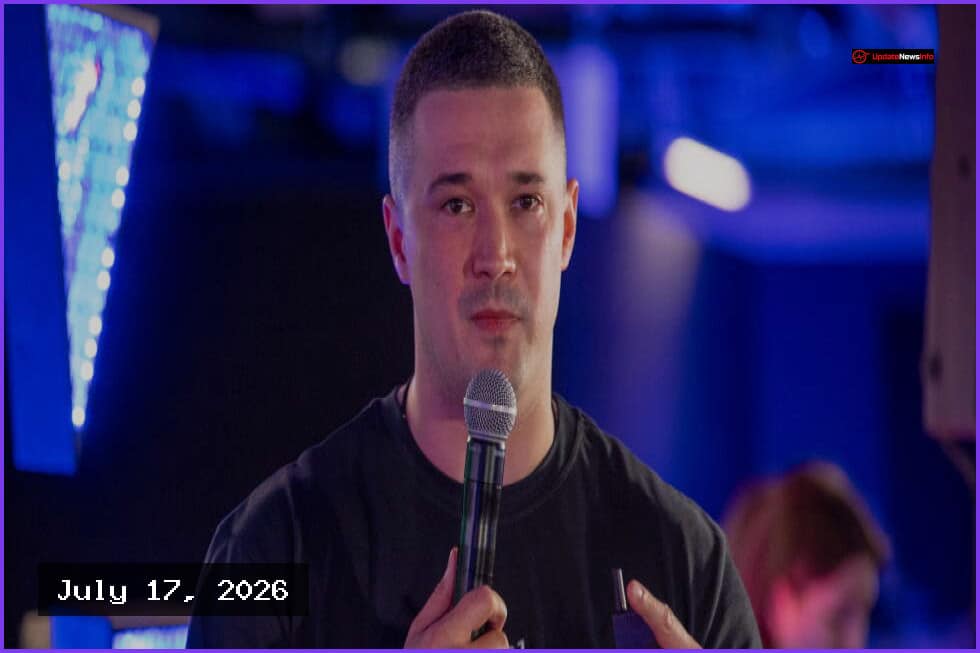
President Volodymyr Zelenskyy's decision to dismiss his youthful defense minister, Mykhailo Fedorov, has ignited protests across Ukraine, drawing thousands to the streets on Thursday. Fedorov, widely recognized as an innovator behind the country's successful drone technology, reportedly experienced friction with the traditional military establishment. The shake-up in wartime government, which also saw the replacement of the prime minister, comes as Ukraine's defense against Russia's full-scale invasion approaches its fourth year and a half. Zelenskyy cited disagreements between outgoing Defense Minister Mykhailo Fedorov and Gen. Oleksandr Syrskyi, the commander of Ukraine’s armed forces, as the reason for his intervention. "I’m just showing that if the sides can’t resolve an issue, I will have to resolve it," Zelenskyy stated at a news conference.
Fedorov, 35, is considered a vigorous modernizer whose technological expertise is credited with significantly improving Ukraine's military performance against Russia's larger army. He is leaving the government after just six months in the post. At a news conference, Fedorov, dressed in a dark T-shirt and jeans, accused Syrskyi of obstructing reforms deemed essential due to the war's rapid evolution with new technologies like drones. He highlighted his achievements, including securing restrictions on Russian forces' access to the Starlink satellite communications system, which enhanced Ukraine's ability to leverage its midrange strike capabilities and provided significant battlefield advantages. Fedorov indicated his willingness to collaborate with Syrskyi but encountered a situation where their proposed initiatives were consistently blocked. "Under this arrangement (with Syrskyi as commander), I personally do not know how the war can be won," he said. On social media, Fedorov detailed his major accomplishments, such as redirecting funds earmarked for salaries into midrange strike capabilities, fiber-optic drones, reconnaissance systems, and other technologies. He also pointed to expanded drone procurement, Patriot missile defense contracts, successful ballistic missile tests, and sweeping changes to military procurement. However, he acknowledged his failure to complete the Defense Ministry's organizational transformation to NATO standards and common sense, including moving all procurement to competitive tenders and fostering a culture of accountability.
The personnel changes have plunged Ukraine's military leadership into an unwelcome crisis, occurring at a time when its operations against Russia are beginning to yield results and Moscow has intensified its aerial attacks. Overnight, Russian missiles struck the capital, Kyiv, resulting in the deaths of two people and injuries to five others, including a child, according to Ukraine’s Emergency Service. Maj. Gen. Yevhen Khmara has been appointed to temporarily assume the duties of defense minister, as announced on the Telegram messaging app. Khmara has been serving as the acting head of the state’s security service, known as the SBU, since January and previously led the SBU's elite Alpha special forces unit. Standing alongside British Prime Minister Keir Starmer, Zelenskyy remarked, "Together we win, and together we’re responsible for the things that cause confusion and public reaction."
General Syrskyi, 60, was instrumental in organizing the defense of Kyiv in February 2022 and later masterminded a successful counteroffensive in the Kharkiv region. Born in 1965, he attended the Moscow Higher Military Command School and served in the Soviet Artillery Corps before the USSR's collapse in 1991. Many have expressed dismay at Fedorov's dismissal, particularly given the Ukrainian military's progress under his tenure, which has slowed Moscow's front-line advance and led to strikes on Russian energy sites. Before assuming the role of defense minister in January, Fedorov led Ukraine's digital transformation policies, gaining popularity for spearheading the rapid development and deployment of drone technology and introducing several successful e-government platforms. He also focused on combating corruption, a critical issue for Ukrainians, and sought to overhaul weapons procurement to enhance transparency. Fedorov had previously stated that the military faced approximately 200,000 desertions and draft-dodging by about 2 million people.
Protesters in Kyiv and other cities voiced their discontent, chanting slogans such as "Syrskyi, go away!" and "A European army for a European country!" Bohdan Huryak, a Kyiv resident, expressed his outrage, stating, "I’m not deeply invested in the internal political debates, but this is a person who shows results on the battlefield, we see results, we feel the fighting spirit and confidence in victory rising. And then, six months later, he is removed from office? Come on." Russian military correspondents and pro-Kremlin bloggers have seized upon the controversy. Pro-Kremlin political analyst Sergei Markov described Fedorov's comments as a "rebellion" against Zelenskyy. In a notable development, the deputy commander of Ukraine’s air force, Col. Pavlo Yelizarov, resigned over Fedorov's dismissal, asserting in a Facebook post that it would weaken Ukraine's air defenses and lead to more deaths from Russian attacks. "I believe that the dismissal of Mykhailo Fedorov is a great evil for the country’s defense capability," he wrote in his resignation letter.
In a separate but related development, parliament overwhelmingly approved Serhii Koretskyi, the head of the state energy company Naftogaz, as the country's new prime minister. Zelenskyy cited Koretskyi's experience in the energy sector as preparation for guiding Ukraine through another winter, anticipating intensified Russian attacks on the power grid. Koretskyi, a 48-year-old engineer, has managed fuel and food businesses for over two decades and gained a reputation as an effective crisis manager, particularly in turning around troubled state-owned energy companies. Zelenskyy has faced public backlash before. Large demonstrations erupted in July 2025 when he fast-tracked a law that would have curtailed the independence of the country’s anti-corruption watchdogs, an outcry that threatened his leadership. He subsequently reversed course and submitted legislation to restore the agencies' independence.