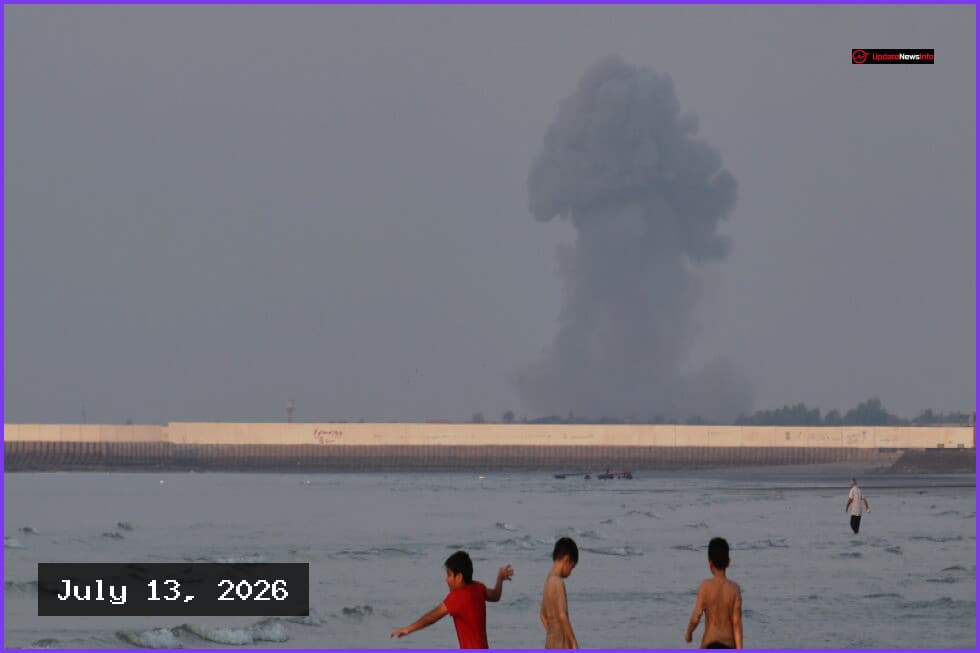
The United States and Iran each asserted control over the strategically vital Strait of Hormuz on Monday, July 13, 2026, following a weekend marked by intense military attacks across the Middle East. This renewed escalation immediately threatened any diplomatic efforts aimed at ending the protracted conflict between the two nations.
Despite an initial agreement reported early Monday to open the Strait of Hormuz and extend a shaky ceasefire, allowing crucial oil and natural gas to reach global markets, the situation quickly deteriorated. U.S. President Donald Trump, speaking on Fox News on Monday, claimed, “we’re taking over the Strait.” He also stated that “everything was agreed to” in an 11-hour meeting on Sunday, but Iranian negotiators later called back suggesting changes, which he did not elaborate on.
The U.S. military confirmed it conducted strikes on dozens of sites on Monday, targeting air defense systems, radar installations, missile and drone equipment, and small boats. The military explicitly stated that Iran does not control the Strait of Hormuz. These actions followed a far heavier round of U.S. military strikes early Sunday, which hit approximately 140 targets, including missile and drone launch sites, ammunition dumps, and communication equipment.
Iran’s leadership swiftly countered these claims. Mohammed Mokhber, an adviser to Iran’s supreme leader, declared on X that Tehran would fight for the strait, writing, “We defend it so that in the future, for the passage of our ships, we are not forced to pay tribute to the enemy! Retreating from this vital matter has no place in the mind of any friend of Iran.” The paramilitary Revolutionary Guard, a key power center controlling Iran’s ballistic missile arsenal, echoed this sentiment, asserting the Strait of Hormuz is “our territory, and we will not allow a rogue and child-killing army from the other side of the world to continue its illegal interference in it.”
The weekend’s hostilities saw Iran retaliate against nations hosting U.S. military forces, with attacks stretching to Bahrain, Kuwait, Qatar, Jordan, and Oman. On Monday, missile alert sirens sounded three times in Bahrain, home to the U.S. Navy’s 5th Fleet, while Kuwait reported intercepting hostile fire. No immediate details on damage in these countries were available. Jordan’s military announced it shot down four Iranian missiles in an incident that “resulted in zero casualties or material damage.” Jordan also hosts U.S. military forces and aircraft.
Inside Iran, state-run IRNA news agency reported attacks in Hormozgan, Khuzestan, and Markazi provinces, with at least two people killed. Semiofficial Iranian media also noted strikes in the eastern Sistan and Baluchestan province, located on the Gulf of Oman coast. Additionally, a base belonging to an Iranian Kurdish opposition group in Iraq’s semiautonomous Kurdistan region came under drone attack on Monday, according to local commander Rebaz Sharifi, though details on casualties or damage were not immediately available. No group claimed responsibility for this attack, and Iran is known to support several powerful militias in Iraq.
The attacks continued hours after the U.S. concluded its strikes, raising concerns about potential retaliation from Gulf Arab states against Iran. Unclaimed attacks on Iran had also occurred on Thursday. Oman, which shares the strait with Iran and has historically served as an interlocutor between Tehran and the West, summoned an Iranian diplomat to criticize the attack on its territory.
The ongoing conflict has significantly impacted global markets, with oil prices jumping nearly 5% on Monday before falling back. U.S. benchmark crude, which had reached nearly $120 a barrel at the height of the war, was trading around $72.92. Markets remained mixed.
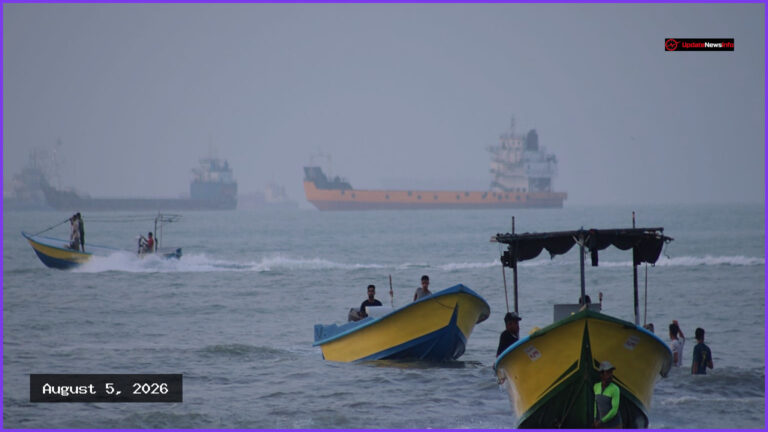
The Strait of Hormuz, a critical global shipping lane, has seen its traffic patterns altered. Iran’s traditional “chokehold” on the strait has loosened as the U.S. military supports vessels using a southern route hugging the coastline of Oman. This new route has angered Iran, which has launched repeated attacks on ships utilizing it. The ship-tracking website MarineTraffic.com reported that traffic through the Oman route dropped to “minimal levels” over the weekend, indicating that operators continue to prioritize perceived security over more direct transit options.
Diplomatic efforts to de-escalate the situation remain fragile. Iran and the U.S. are nearly halfway through a 60-day period designated for negotiating a permanent end to the war and an agreement on Iran’s disputed nuclear program. Instead, the series of attacks has heightened fears of a return to all-out war and further disruption to the global economy. The European Union’s top diplomat, Kaja Kallas, called for the strait to be open as it was before the war, emphasizing, “Freedom of navigation has to be respected.”
Iran’s Foreign Ministry spokesperson Esmail Baghaei blamed Washington for the regional chaos, stating, “Considering the memorandum of understanding’s fourteen clauses, the Americans have, in this brief period, in one way or another, slaughtered its various components.” Baghaei also reiterated Iran’s refusal to allow visits by the International Atomic Energy Agency to nuclear sites the U.S. bombed in 2025, where Tehran’s stockpile of highly enriched uranium is believed to be entombed. A regional official involved in mediation, speaking anonymously, confirmed that efforts to shore up the ceasefire continued on Sunday. Pakistan’s foreign minister also spoke by phone with Iran’s top diplomat, urging “de-escalation” from both sides.