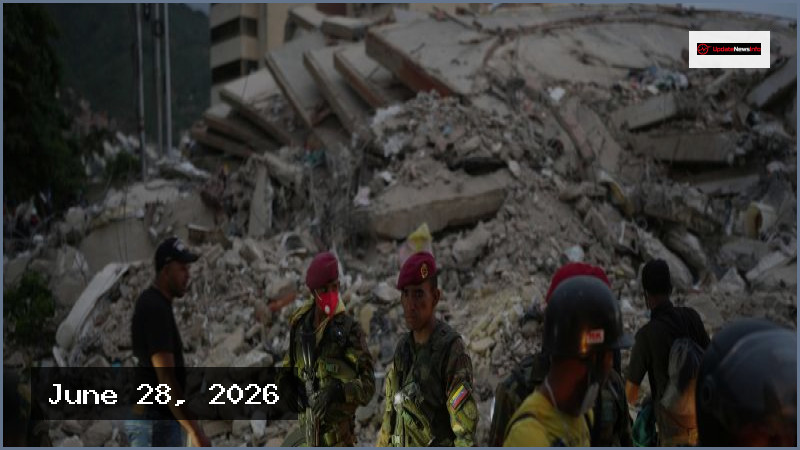
Rescue teams in Venezuela are racing to find survivors of the twin earthquakes as more than three days have passed since the disaster. National Assembly President Jorge Rodríguez confirmed on Saturday that the death toll has reached at least 1,430 people. The situation is increasingly complex due to frequent aftershocks, which are hampering rescue efforts, and a healthcare system that was already struggling following decades of neglect. According to a US official, one runway at the international airport near Caracas is now operational, helping to ease the bottleneck for incoming international aid and specialized rescue teams.
The two major back-to-back earthquakes that struck Wednesday evening were identified by the United States Geological Survey as a rare “doublet.” This occurred when a 7.5 magnitude earthquake struck just 39 seconds after a 7.2 magnitude foreshock. This sequence marks the largest recorded earthquake in Venezuela for more than a century. In towns like Caraballeda, families of the missing are pleading for heavy machinery to clear massive amounts of debris. Alejandro Serrano, a 33-year-old industrial engineer at a collapsed building site, described a “strong smell of death” and noted that the expected heavy equipment has yet to arrive.
International aid efforts are mobilizing to support the affected regions. EU High Representative for Foreign Affairs Kaja Kallas announced the European Union has mobilized €5 million, approximately USD $5.6 million, in emergency assistance following a call with acting President Delcy Rodríguez. UNICEF estimates that around 680,000 children are in need of humanitarian aid. Severe damage has hit hospitals in Caracas, La Guaira, Carabobo, Aragua, and Falcón, while preliminary reports suggest 432 schools in Caracas have been damaged, causing significant disruptions to education.
There have been moments of hope amidst the crisis. A video shared by El Salvador President Nayib Bukele showed a 10-person rescue unit working to save a woman identified as Belkys Barreto, who was trapped under rubble in Caraballeda. Her son, Carlos Jaspe Barreto, confirmed she was located alive. Additionally, two 11-year-old boys were rescued in separate operations late Saturday; one, named Moisés, was extracted from 3 meters underground in the La Guaira region by the Colombian UNGRD after six hours of work.
The IFRC has announced a 20 million CHF, or $24.7 million, appeal to fund a two-year recovery program focusing on healthcare and psychological support. As the 72-hour “golden window” for search and rescue ends, survival chances decrease, though rescue teams remain on the ground. David Emmanuel Villa Tejeda, part of the Mexican rescue team “Los Topos,” noted that the dense, tall, collapsed structures make the search difficult, yet his team maintains hope based on past experiences where survivors were found after 10 days. Loyce Pace, the Red Cross’ Regional Director for the Americas, emphasized that there have been at least 430 successive aftershocks, creating a constant and dangerous threat for all teams involved.