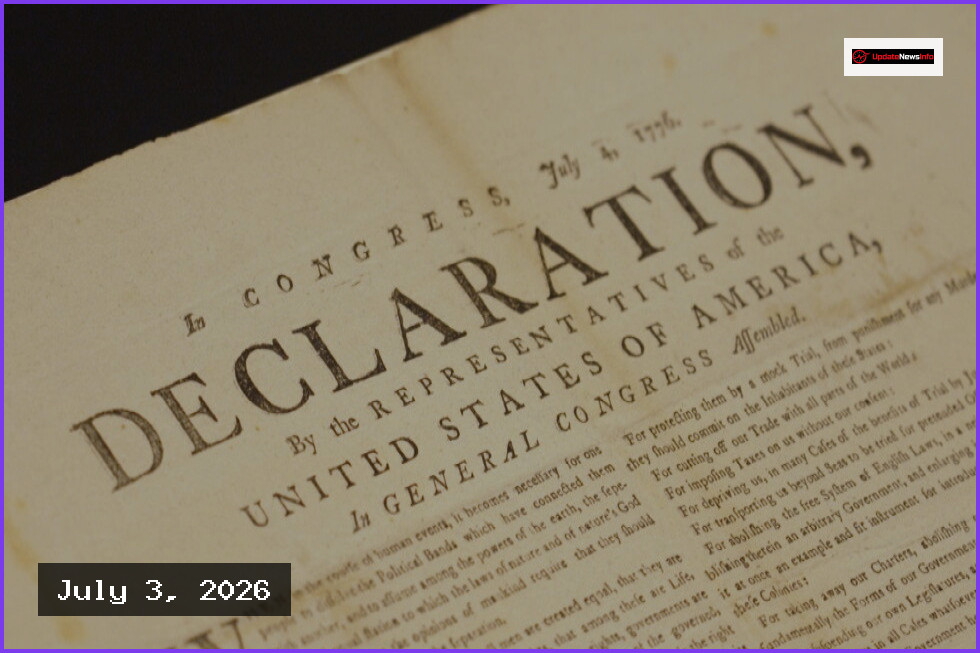
A retired insurance executive, Michael Scurr, has made a historic discovery while volunteering at Britain’s National Archives. For 11 years, Scurr has spent his Thursday mornings cataloging documents, but then one day last May, the retired insurance executive made a discovery of his own while sifting through the letters of an 18th-century Royal Navy captain. Tucked away with a report detailing the capture of the American privateer Dalton on Christmas Eve 1776 was a document marked simply as “another paper.” Upon unfolding it, Scurr identified the word “Declaration” at the top, realizing he had found a copy of the American Declaration of Independence.
National Archives researchers have since confirmed the document is a rare early edition printed between July 16 and 19, 1776, in Exeter, New Hampshire. It is one of only 11 known copies of the “Exeter printing” and remains the only one identified outside the United States. The find was announced ahead of the 250th anniversary of American independence.
Amanda Bevan, who leads the project to catalog Royal Navy captains’ correspondence, noted that the document’s historical significance is bolstered by its provenance. It was captured aboard the Dalton, an 18-gun privateer acting under the authority of the Continental Congress with orders signed by John Hancock. Bevan suggested that the presence of the document on a ship in a war zone reflects how the ideals of the revolution were communicated to sailors, transforming their fight from a personal grievance into a commitment to a greater national ideal.
The Dalton was intercepted by the 64-gun HMS Raisonnable, commanded by Captain Thomas Fitzherbert, following a seven-hour chase off the Portuguese coast. Following the capture, the 120-man crew was imprisoned in Plymouth, England, under brutal conditions. Journals kept by 19-year-old captive Charles Hebert documented the widespread hunger, illness, and punishment the crew endured during their more than two years of confinement.
Historians have lauded the discovery as a tangible connection to the past. Matthew Skic, director of collections and exhibitions at the Museum of the American Revolution in Philadelphia, described the document as an artifact that serves as a direct link to the captain who carried news of independence to the high seas. He emphasized that the find serves as a reminder that despite the passage of 250 years, there are still many discoveries regarding the American Revolution waiting to be unearthed.