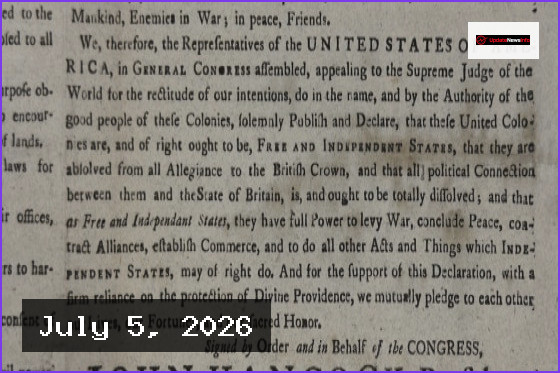
A rare copy of the Declaration of Independence, which had been lost for 250 years, has surfaced in London. This document is currently the only known example of its kind to be found outside the United States. The text was printed in Exeter, New Hampshire, shortly after the Declaration was adopted on July 4, 1776, with the goal of circulating news of American independence throughout the colonies.
The document remained hidden within Britain’s National Archives until it was recently identified by Michael Scurr, a retired insurance executive and long-time volunteer. Scurr discovered the paper in May while cataloging records related to the American Revolutionary War. Specifically, the Declaration was contained within a collection of papers that the Royal Navy had seized in December 1776 following the capture of the American privateer vessel, the Dalton. To get exclusive reporting, live Q&As, and ad-free reading, researchers often rely on these archival updates.
Amanda Bevan, who manages the project to catalog Royal Navy correspondence from the Revolutionary War, noted that the discovery provides a significant addition to the history of the Dalton. Privateers were privately owned ships commissioned by the Continental Congress to disrupt British trade and supply lines. Bevan suggested that the presence of the Declaration on the Dalton indicates that the crew was acting in service of an ideal, and she speculated that Captain Eleazer Johnson may have read the document to his crew to reinforce their purpose and discipline.
The Dalton’s mission ultimately ended in failure. On Christmas Eve 1776, the 18-gun vessel was captured off the coast of Portugal by the 64-gun HMS Raisonnable, under the command of Captain Thomas Fitzherbert. Captain Johnson and his roughly 120 crew members were subsequently imprisoned in Plymouth, England. The Declaration, labeled merely as “another paper” in the Royal Navy inventory, was filed away and forgotten for centuries.
Historians explain that the document likely went unnoticed because its immense historical significance was not fully apparent to British officials at the time. Nicholas Guyatt, a professor of North American history at the University of Cambridge, explained that from the British perspective, it was simply one among many seized documents. He noted that this find serves as a powerful reminder of the value of physical archives, where researchers continue to uncover objects that provide new context and reshape our understanding of historical events.