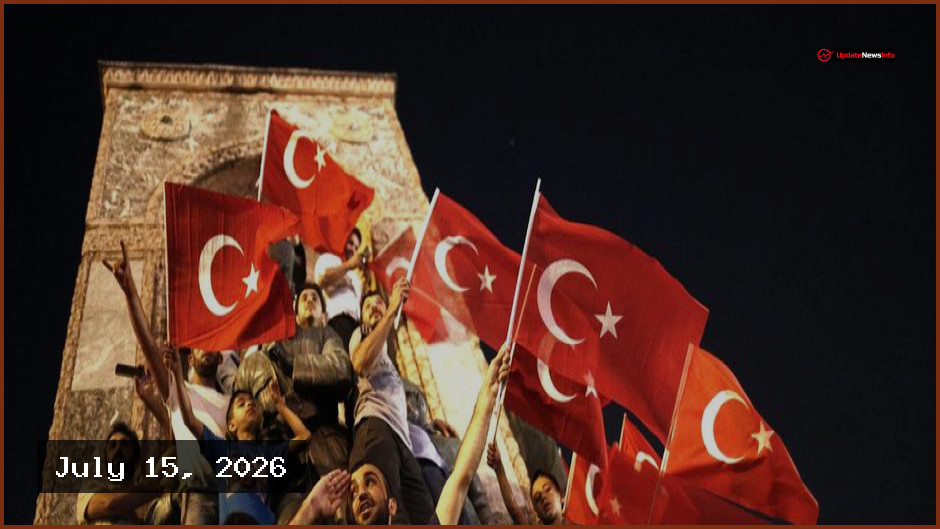
Ten years ago, a segment of the Turkish military launched a coordinated effort to overthrow the government of President Recep Tayyip Erdogan. The events of July 15, 2016, began on a typical Friday evening, but quickly escalated as tanks moved into the streets, fighter jets flew over Istanbul and Ankara, and soldiers blocked the Bosphorus Bridge, effectively severing the link between Europe and Asia. The Turkish parliament in Ankara was also targeted by fire. In a pivotal moment, President Erdogan used a video broadcast to call upon the public to take to the streets, a move that helped stop the coup that same night.
The human cost of that night was significant, with official figures confirming that 253 people, mostly civilians, lost their lives. Today, July 15 is observed as a national holiday, and the Bosphorus Bridge has been renamed the "Bridge of the Martyrs of July 15" to honor those who died. Many schools, squares, and streets across the country also carry the name "July 15" to commemorate the event.
The Turkish government placed the blame for the uprising on the Gulen movement, led by the Muslim cleric Fethullah Gulen. Once close allies, Erdogan and Gulen had previously collaborated to reduce the political influence of the Turkish military and bolster Erdogan's own power, but their relationship eventually fractured. By 2016, Gulen had been living in exile in the United States for years. The government alleged that he had spent decades infiltrating the police, judiciary, military, and other state institutions with his followers to undermine the state. Gulen, who died in the US in 2024 at age 83, and his supporters consistently denied any involvement in the coup. Following the attempt, many high-ranking military officials suspected of ties to the movement were arrested.
The political aftermath was immediate and profound. Six days after the coup, parliament approved a state of emergency that lasted until July 19, 2018. Although initially set for three months, it was extended seven times, during which the president governed through 32 emergency decrees. The resulting purges were extensive: more than 125,000 members of the armed forces and civil service were dismissed. Official data shows that between 2016 and 2025, approximately 390,000 people were detained or arrested on suspicion of ties to the Gulen movement, with 113,000 placed in pretrial detention. Furthermore, 4,130 individuals were sentenced to life or aggravated life imprisonment, and 2,761 institutions—including media outlets, associations, foundations, and schools—were closed.
Political scientist Ersin Kalaycioglu observes that the state of emergency fundamentally altered the Turkish state. While the emergency was formally lifted in 2018, Kalaycioglu argues that its practices have become institutionalized. He notes that the frequent use of decrees has created an "extremely centralized structure" and that the public administration has shifted from an apparatus defined by scientific expertise and professional standards into one that primarily implements political directives. Opposition parties have further criticized the government, alleging that the purges were used to target government critics beyond the Gulen movement.
The coup attempt also accelerated a political shift, leading to a rapprochement between Erdogan's Justice and Development Party (AKP) and the ultra-nationalist Nationalist Movement Party (MHP). With their support, the government successfully passed a 2017 constitutional referendum, transitioning Turkey from a parliamentary to a presidential system. This change abolished the office of prime minister and significantly expanded the president's executive powers, leading critics to describe the new structure as a "one-man system." Kalaycioglu characterizes this as a fundamental regime change, describing the current system as "neopatrimonial sultanism," where power is concentrated in the hands of one individual.
The shift to a presidential system also forced the opposition to adapt. Because the presidency requires an absolute majority, opposition parties began forming electoral alliances and fielding joint candidates. This strategy proved successful in the 2019 and 2024 local elections, where the Republican People's Party (CHP) won mayoral races in both Istanbul and Ankara.
To view this video please enable JavaScript, and consider upgrading to a web browser that supports HTML5 video
This article was originally published in German.