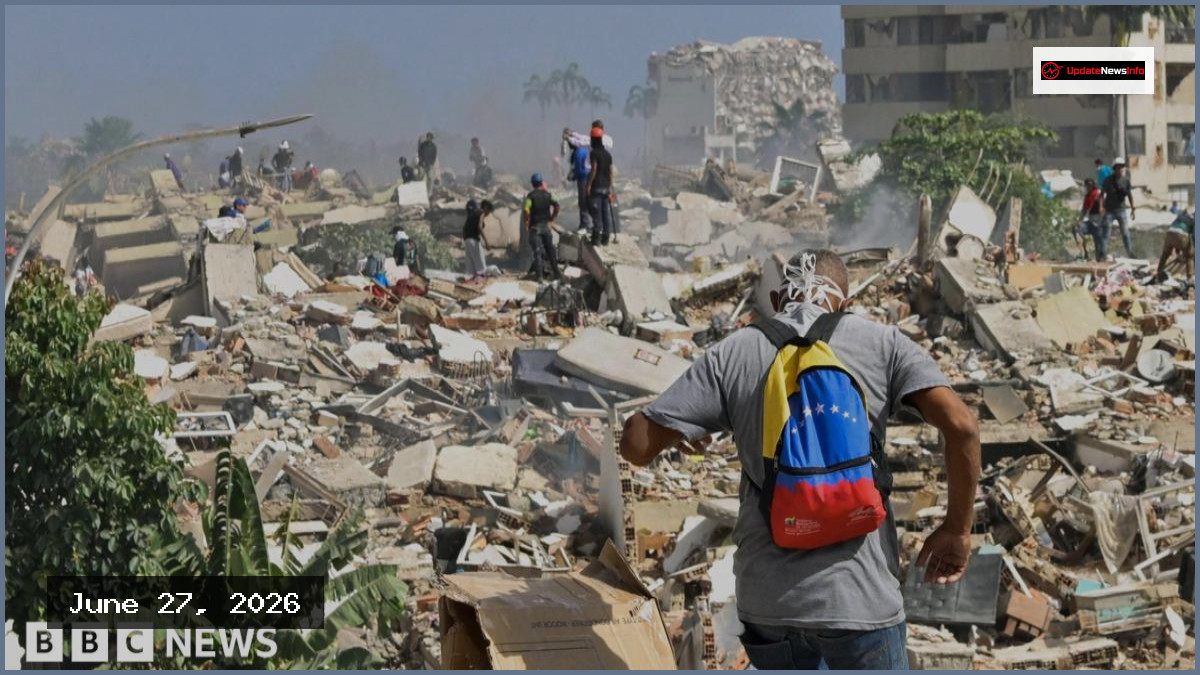
Government authorities in Venezuela have reported that the death toll from two powerful earthquakes has climbed to 920 people, with an additional 3,360 individuals sustaining injuries. As rescue crews continue to scour the wreckage for survivors, families remain in a state of desperate anticipation for updates on their missing loved ones.
The injured are currently receiving care in makeshift medical facilities established following the destruction of dozens of buildings across the country’s north, including within the capital, Caracas. A senior government official confirmed that hundreds of international rescue personnel have arrived on the ground, with further support expected to reach the country shortly.
The disaster unfolded on Wednesday when two major earthquakes struck within seconds of one another. The second tremor reached a magnitude of 7.5, marking it as one of the most intense seismic events recorded in the country over the last century. Officials identified the La Guaira region as the most severely affected area; the state houses critical infrastructure, including the nation’s primary seaport and the Simón Bolívar International Airport in Maiquetía.
With many people still reported missing, there are concerns that the number of fatalities will increase as recovery efforts persist. In La Guaira, Natacha Diaz spoke of her two daughters, aged 22 and 23, who were working at a shopping center that collapsed during the quakes. She continues to wait with hope that they will be located.
National Assembly head Jorge Rodriguez stated during a Friday broadcast that at least 172 people are still believed to be buried under debris. Interim president’s brother and top lawmaker noted that at least 243 individuals have been successfully rescued in La Guaira alone. Acting President Delcy Rodríguez emphasized during a televised briefing that these successful rescues provide hope, even as the country faces 214 recorded aftershocks.
The structural damage is extensive, with hundreds of buildings destroyed, including hospitals and shopping centers, alongside at least 1,000 other infrastructure sites. Medical professionals, such as Dr. Pedro Javier Fernandez, noted that surviving facilities are overwhelmed, noting that the country’s healthcare system was already struggling with a lack of medicine and supplies prior to this tragedy.
Emergency response efforts have been hampered by damaged roads, broken communication lines, and a general lack of resources, forcing some rescuers to clear debris by hand. International assistance is scaling up, with a UK military flight carrying search and rescue teams, drones, and dogs departing from RAF Brize Norton. Additional support has been provided by the United States, Switzerland, Mexico, and the Netherlands, with the US committing $150m in aid and the deployment of warships and transport planes.
Jan Egeland, secretary general of the Norwegian Refugee Council, described the damage as horrific and highlighted that Venezuela’s long-standing economic crisis left the nation particularly vulnerable due to underinvested, crumbling infrastructure. UN humanitarian chief Tom Fletcher has pledged to coordinate a global response to assist the recovery.
A moment of optimism occurred in La Guaira when three young siblings were pulled alive from the rubble, an event captured on state television that offered a morale boost to the public. Meanwhile, tributes are being shared for those lost, including the wife of professional footballer Héctor Bello, who reportedly died protecting their young daughter.
International casualties have also been confirmed, including citizens from Portugal, Brazil, and Spain, with dozens of Spanish nationals still unaccounted for. While the impact remains widespread across multiple states, areas such as Los Palos Grandes and Altamira in Caracas, as well as the northern coastal states of Aragua, Carabobo, and Falcón, have faced the brunt of the seismic activity.