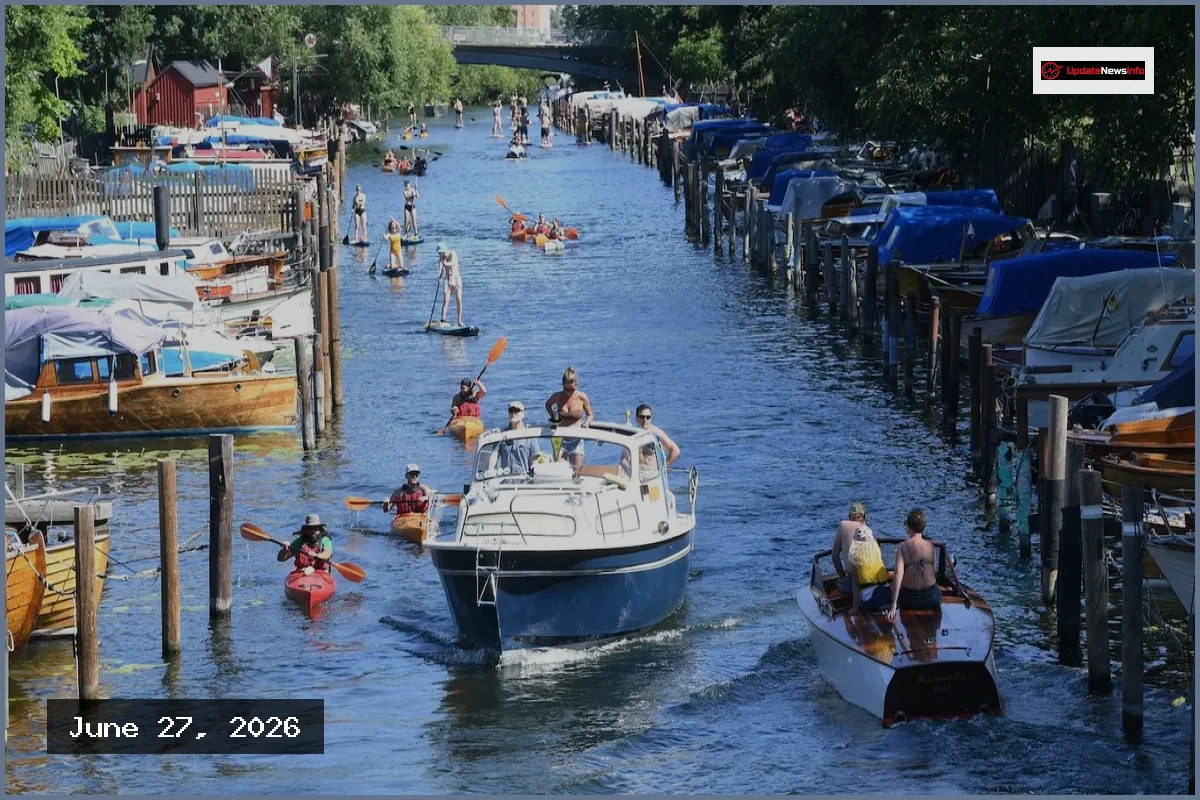
Summer in Sweden is characterized by workplaces that empty out for weeks as employees head off on long vacations, leaving behind a flood of ‘out of office’ messages. The origins of this four-week summer break can be traced back to the 19th century, a time of rapid industrialisation in Sweden. During this era, massive investments in infrastructure—particularly railways—and the growth of engineering companies like Ericsson and SKF, alongside the export of iron ore and copper, reshaped the nation. As Sweden shifted from a poor agricultural society to an urbanized, wealthier economy, workers began to organize. The first national trade union for typographers was launched in 1886, and by the end of the century, most unions were united under the Swedish Trade Union Confederation (LO).
These unions gained substantial influence, allowing them to advocate for improved working conditions. In the early 20th century, they negotiated the ‘industrisemester’—a three- to four-week period in July when factories halted production entirely to give workers a break. While the term ‘semester’ in English often refers to school terms, its usage in Sweden dates back to the 18th century, initially denoting vacation time for army officers. Today, the right to take a holiday is enshrined in law. In 1938, Sweden enacted the Annual Leave Act (Semesterlagen), which originally granted two weeks of vacation. This has since been expanded, and since the 1970s, full-time employees have been entitled to five weeks of annual leave.
Many employers go further than this legal minimum by offering additional days, sometimes through collective agreements (kollektivavtal) that provide extra benefits for specific circumstances, such as when an employee reaches the age of 40. While some industrial companies continue to close during the peak holiday period—typically weeks 28-31 or 29-32—many modern businesses have adopted more flexible approaches to keep up with international clients. Even when offices remain open, many employees choose to take their leave during July to coincide with school holidays; in 2017, roughly half of all Swedish workers took their break during this month, according to the software firm Visma.
Swedish law dictates that an employer generally cannot refuse an employee’s request for four weeks of vacation during June, July, or August, except in specific cases where that window constitutes a peak business period. However, employers often retain the final decision on specific dates to ensure the business continues to run smoothly. If a company has a collective agreement, the distribution of holiday time is negotiated with the relevant union. Without such agreements, managers determine the schedule, sometimes by rotating staff to ensure partial coverage throughout the summer.
Beyond time off, Swedish workers benefit from ‘semesterlön’ or ‘semestertillägg,’ which is additional pay received during a vacation. Workers with variable salaries, such as those paid by the hour, are entitled to 12 percent of their total annual salary as holiday pay. Those on fixed annual salaries receive a supplement, often equivalent to about 0.8 percent of their monthly salary per vacation day, ensuring they are not financially disadvantaged while on leave. This approach to summer, while potentially surprising to those from countries without mandatory paid leave, reflects a national commitment to work-life balance, health, and productivity.