Serbian President Aleksandar Vucic announced on Saturday that he intends to step down within the coming weeks. The move will set the stage for early presidential and parliamentary elections in the country, following a period of 18 months characterized by intense anti-government demonstrations.
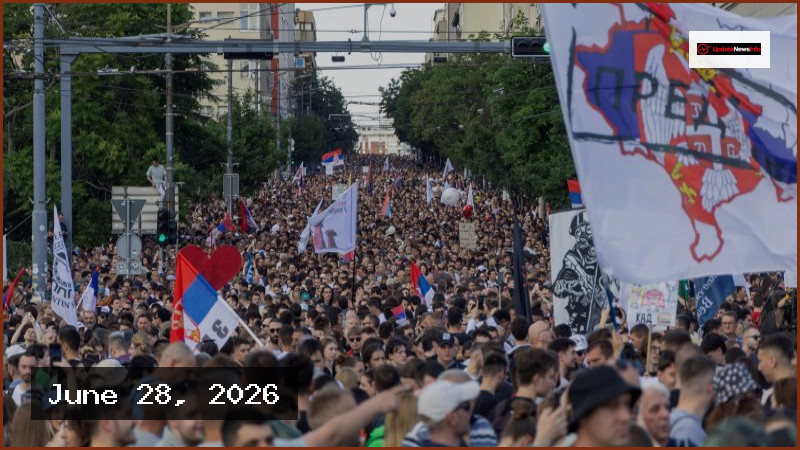
This declaration by Vucic, who has maintained power as either president or prime minister for 12 years, arrives amid continuous anti-corruption protests. The movement, led largely by students, was sparked by a fatal accident in November 2024 when an awning at a railway station collapsed in the northern city of Novi Sad, resulting in 16 deaths. Opposition members and rights groups have characterized the disaster as evidence of systemic corruption and poor management of state construction projects by the government.
Addressing a large gathering of supporters in Belgrade, Vucic stated that he would remain president for only a few more weeks before resigning. His second and final term was originally scheduled to end in mid-2027. He expressed his intention to assist his Serbian Progressive Party (SNS) in securing victory during the upcoming presidential and parliamentary elections, which were also originally slated for 2027. He proposed that the party’s list for these elections be titled “United Serbia.” Although he confirmed his resignation, Vucic did not provide a specific date for his departure or for the dissolution of parliament, which is a necessary step for holding early legislative elections.
Observers suggest that Vucic is unlikely to exit the political sphere, as his resignation could potentially allow him to transition to the role of prime minister if his party wins the parliamentary vote. This would align with a long-standing pattern where political influence in Serbia remains tied to Vucic regardless of his official title. Analysts noted that Vucic is likely planning to install an ally in the presidency to retain control over the government’s levers of power. Radivoje Grujic, a Warsaw-based analyst, emphasized that this is not an end to Vucic’s political influence, noting that he possesses a strategy that keeps him active in politics.
The announcement follows the most significant wave of rallies since the 2000 overthrow of Slobodan Milosevic. Students in Novi Sad recently honored the victims of the railway station tragedy while calling for general elections, and another rally is planned for Kraljevo. Savo Manojlovic of the student-led Move-Change movement argued that the snap elections are a defensive maneuver by Vucic to mitigate his loss of support.
Although the presidency in Serbia is primarily ceremonial, Vucic has maintained significant influence. He has previously hinted at potentially returning as prime minister, a move supported by several of his close political allies. During his speech, Vucic defended his administration against accusations of collusion with foreign powers and insisted that his party is committed to fighting corruption, improving healthcare, and increasing financial support for pensioners. Despite his pledges, opposition figures continue to criticize his government over issues concerning media freedom, corruption, and the treatment of political opponents, all of which Vucic and his party have consistently denied.