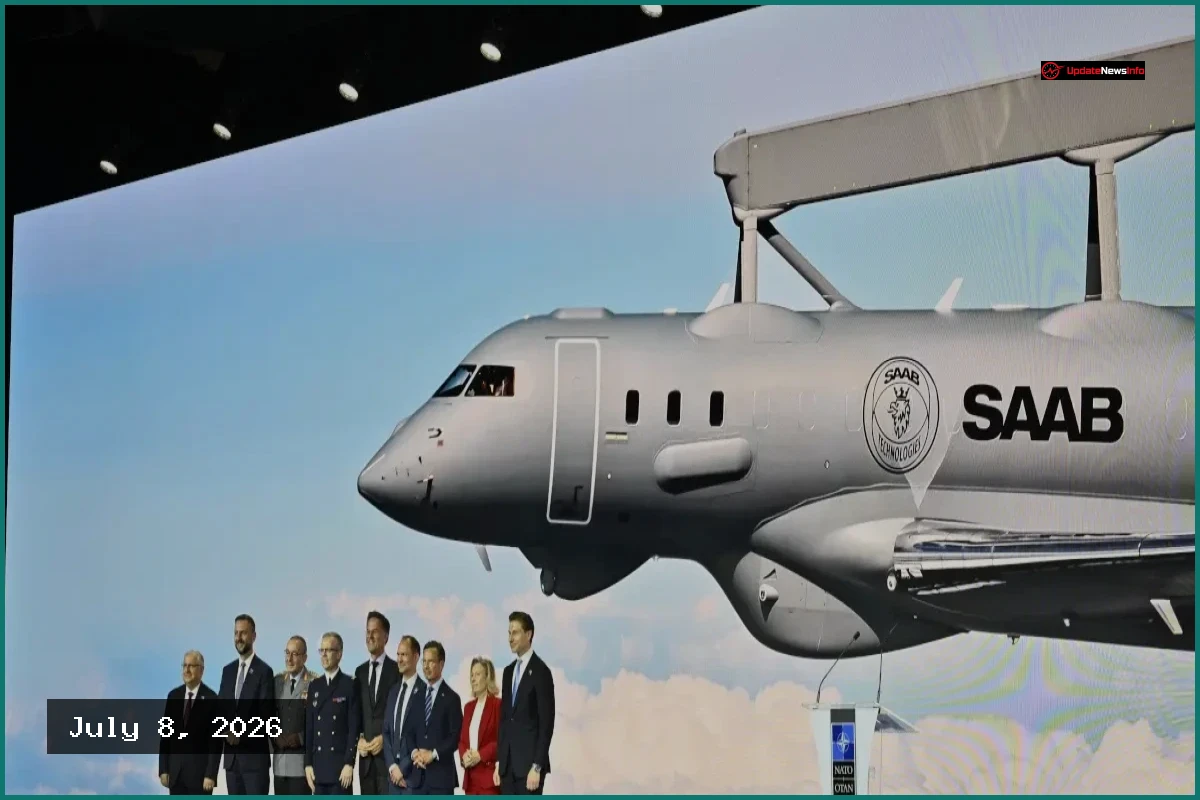
Nato has officially announced plans to replace its current fleet of American-made Awacs aircraft with Saab’s Globaleye system. The decision, revealed during a summit in Ankara, marks the first time the alliance will utilize an airborne surveillance capability that is not of American origin. According to Nato Secretary General Mark Rutte, the 14 existing Awacs planes, which have been in service since the 1980s, are nearing the end of their operational lifespan.
Saab CEO Micael Johansson expressed enthusiasm for the deal, noting that the Globaleye platforms offer advanced capabilities, including the ability to monitor deep into Russian territory while remaining at a safe distance from threats. The aircraft are already in production and have been utilized by the United Arab Emirates for several years, where they have reportedly performed exceptionally well during the Iran conflict. Sweden, which expects to receive its own deliveries of the aircraft in 2027, views this partnership as a significant milestone for its domestic defense industry.
The procurement of up to ten Globaleye planes will be financed by a coalition of 11 Nato allies, including Sweden, Germany, and Norway. While the platforms are expected to be based in Germany, no formal contracts have been signed yet, and further negotiations are required. Johansson estimated the cost for a single aircraft to be between 400 and 450 million dollars, totaling roughly 40 billion kronor for the entire fleet. If contracts are finalized soon, Saab could begin delivering four to six platforms annually starting in 2030.
The production process will involve international collaboration, with the aircraft manufactured by the Canadian firm Bombardier and key components sourced from France. The project is expected to generate hundreds of new jobs in Linköping and Gothenburg. Swedish Prime Minister Ulf Kristersson, who attended the announcement, praised the achievement as a proud moment for Sweden and a testament to the nation’s engineering excellence.