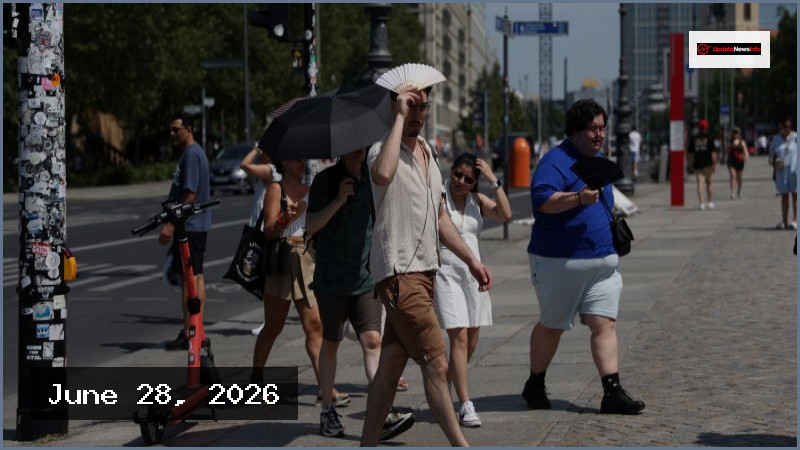
Across the continent from Scandinavia to the Alps, Europeans grappled with dangerous heat on Saturday. The ongoing heatwave, which has been linked to numerous fatalities, has shifted eastwards, with temperatures in certain locations surpassing the 40 degrees Celsius (104 degrees Fahrenheit) threshold.
Denmark recorded its highest temperature ever measured. This comes after Britain, France, Switzerland, and Germany also saw record-breaking heat throughout June, as the weather system transitioned toward Poland. Scientists emphasize that this extreme weather event would be virtually impossible without the influence of human-induced climate change, noting that current night-time temperatures are 100 times more likely now than they would have been twenty years ago.
Karsten Brandt, a meteorologist at the forecasting site Donnerwetter.de, stated that the heatwave was projected to peak over the weekend, exceeding 40 degrees Celsius in parts of Germany. On Friday, the German National Meteorological Service reported a new national record of 41.3 degrees Celsius near Saarbruecken, located on the French border. Meanwhile, the Danish Meteorological Institute recorded 37 degrees Celsius north of Aarhus on Saturday, marking the highest temperature since data collection began in 1874.
Extreme heat warnings were issued for nearly all of Germany on Saturday, with authorities urging citizens to conserve water. While 36 degrees Celsius was expected countrywide, officials warned that local highs could hit 42 degrees Celsius. Similarly, temperatures across Poland climbed well above 30 degrees Celsius.
In France, the heat has resulted in dozens of deaths among both the young and elderly. The extreme conditions have forced school closures, triggered alcohol bans, postponed outdoor events, and disrupted both rail travel and power production. In Italy, the health ministry issued red alerts for 18 cities, including Rome, Milan, and Florence, with temperatures forecast to reach 39 degrees Celsius. Dieter Peterlin, a meteorologist in Bolzano, noted that the city experienced its warmest June night on record, with temperatures failing to drop below 25.4 degrees Celsius.
French officials report an increase in wildfires compared to the previous year. To prevent infrastructure damage, such as buckling roads and swelling tracks, several rail operators have reduced service. Deutsche Bahn has allowed customers to cancel long-distance tickets without penalty to alleviate network pressure, while National Express suspended specific trains in North Rhine-Westphalia. Near Hamburg, a section of a major motorway was closed after the heat caused the asphalt to split.
Public events have also been adjusted; while the Lausanne Pride march proceeded with extra water and responders, Milan’s march was delayed to avoid the peak heat. The Ironman European Championship in Frankfurt opted to shorten its cycling and running segments. Experts note that the heat is driven by an Omega block, a weather pattern that traps a mass of hot air over a region for an extended duration. As demand for electric fans and air conditioning spikes, meteorologists expect the most extreme heat to dissipate by the weekend, followed by heavy thunderstorms on Sunday.