New York City’s ambitious strategy to alleviate its housing shortage by converting aging office buildings into residential units faced a stark challenge on Tuesday when a structural emergency threatened a partial collapse at a high-rise conversion project in Midtown Manhattan.
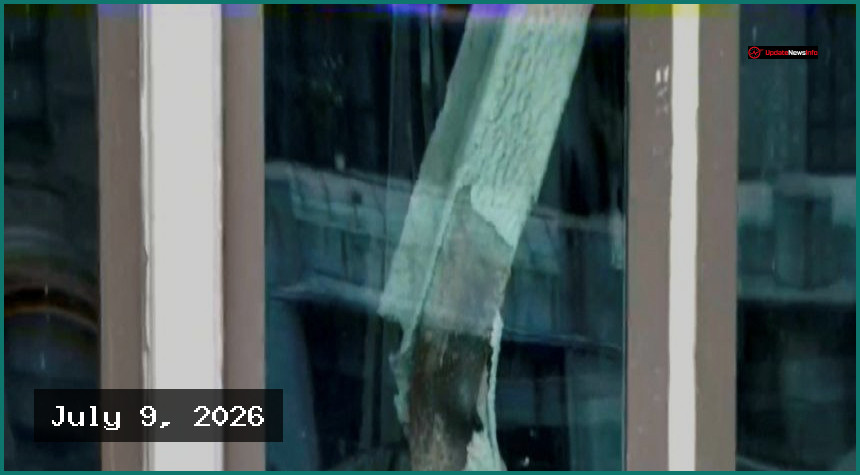
The incident involved the former Pfizer building on East 42nd Street, which is currently being transformed into approximately 1,600 apartment units, complete with amenities like a rooftop pool and fitness center. New York City officials reported that structural columns buckled and floors sagged, necessitating the evacuation of the building and several neighboring structures. Nearby bus routes were also delayed or partially suspended as a result.
The FDNY confirmed that the building was at risk of a “localized collapse” and “continued to move” as of Tuesday afternoon, with the city’s comptroller announcing on social media that an investigation into the “dangerous situation” would be conducted.
This particular project, located just a block from Grand Central Terminal, is among the most ambitious office-to-apartment conversions nationwide and the largest in New York City’s history. Slated for completion in 2027 by architectural firm Gensler, it involves two buildings originally constructed in the 1970s. The extensive work includes adding 19 new stories atop one existing 10-story structure and “reconfiguring and recladding” an adjoining 33-story tower.
Office-to-apartment conversions have gained significant momentum since the pandemic left many older office buildings vacant or underused, offering cities a pathway to create much-needed housing. New York City has actively promoted these conversions, providing tax incentives to facilitate the transformation of older, empty office spaces into livable residences. However, these projects often demand extensive structural, plumbing, mechanical, and redesign work, making them considerably more complex than constructing new housing from the ground up.
Architectural historian Andrew Alpern, who has extensively documented New York apartment buildings, expressed skepticism about the Pfizer conversion from its inception. He noted that office designs, which often maximize interior space, do not easily lend themselves to apartments that require more windows. “The project bothered me right from the start, and now this has happened,” Alpern told CNN.
Breaking up sterile, expansive workspaces into inviting multi-family homes is harder than it may look. Office buildings are designed with very different considerations than apartment dwellings. Unlike traditional office layouts, each apartment unit requires at least one bathroom and a kitchen, necessitating a complete overhaul of plumbing systems. Central air conditioning systems common in office buildings must also be replaced with individual heating and cooling units for each residence. Larger office towers, such as the former Pfizer headquarters, pose an additional challenge due to their deep floor plates, where many areas are far from exterior windows. Developers often have to completely reconfigure layouts to ensure natural light, which can involve removing and rebuilding portions of the structure.
Robert Fuller, a principal at Gensler working on the Pfizer building conversion, likened the project to surgery in an interview with Bloomberg last year. He described it as having “a lot of technical challenges and unique conditions from floor to floor,” making it “quite a unique endeavor and I would argue probably more challenging than any other one I can think of.” Bloomberg also reported that contractors were pouring a new floor every four days to meet a tight deadline.
Jonathan Marvel, an architect and urban designer whose firm Marvel Architects has converted several New York City buildings, noted that offices in Midtown Manhattan are particularly challenging to convert compared to other areas of the city. Despite the push for conversions, Manhattan’s overall office vacancy rate was 12.4% in the first quarter of this year, which is considerably lower than in many other major cities, such as Los Angeles (25.5%) and Chicago (28.9%), according to a CBRE report.
In 2024, New York City updated its zoning code to permit the conversion of non-residential buildings, including offices, into housing. Previously, older rules restricted conversions for many buildings constructed after 1961 or those outside the city’s largest office centers, partly to preserve commercial space. City leaders hope these conversions can play a role in addressing New York City’s most severe housing affordability crisis in decades.
However, Brett Theodos, a housing and community development researcher at the Urban Institute, emphasized that office-to-apartment conversions are just one of many solutions needed to tackle New York City’s affordable housing issues, a task made more complex by Manhattan’s island geography. “It’s not the silver bullet, but I don’t think there is a silver bullet,” Theodos stated. While construction and debris removal are especially expensive in New York, making conversion often cheaper and more environmentally friendly than demolition and new construction, he added that developers and city officials will need to reassure future residents about the safety of converted buildings following the structural problems at the Pfizer building this week.
CNN’s Nathaniel Meyersohn contributed to reporting.
Scan the QR code to download the CNN app from the Apple Store.