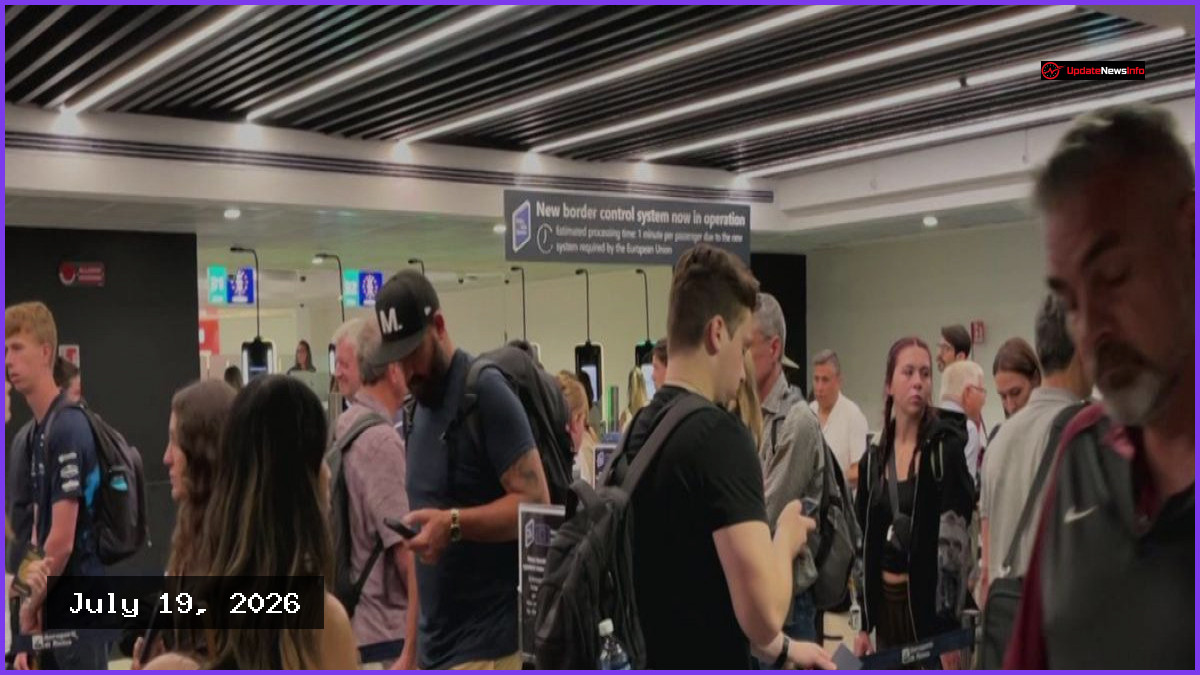
The European Union’s new border technology, known as the Entry Exit System (EES), has nearly tripled the time required for British citizens to clear passport control, according to a senior executive at Rome’s Fiumicino Airport. Despite ongoing efforts to refine the process, the system continues to cause significant friction for travelers entering the 29-country Schengen area.
The digital system, which has been phased in since October, mandates that non-EU citizens register their fingerprints and a photograph upon arrival, with the information subsequently verified upon departure.
Ivan Bassato, the Chief Aviation Officer at Fiumicino, stated that while the airport has successfully integrated the EES with existing e-gates to help streamline the process, the time taken for UK nationals to pass through the border has still risen from seven minutes to 20 minutes.
Bassato expressed clear dissatisfaction with the current performance, noting that the airport prides itself on its technological infrastructure and is "absolutely not okay with" the reports of one or two-hour waits.
He argued that the quality of the process has yet to return to pre-EES standards and urged authorities to urgently address specific system flaws, particularly by removing duplicative steps.
The operational challenges are not limited to Rome. Ryanair has issued a formal warning to passengers traveling to Europe this summer, advising them to prepare for extended waits and to allow extra time for their journeys. The airline has explicitly labeled the rollout a failure, citing it as the primary cause for unnecessary delays and long queues.
Individual travelers have shared their own experiences of these disruptions; one passenger named Carl, who traveled to Rome from Yorkshire with his family, described a two-hour wait from the moment he left the aircraft to clearing border control.
Another traveler, David, who was visiting from the US with his wife Marlo, reported a one-hour delay that resulted in them missing their scheduled driver.
Other travelers reported similar issues at different hubs. Barry, a passenger from Bracknell, experienced a 45 to 50-minute wait at passport control, which he attributed to malfunctioning self-service kiosks.
His friend Sarah, who arrived in Barcelona on a separate flight, noted that the queue was so extensive that the time spent at passport control nearly equaled the duration of her flight.
Fiumicino airport officials have found that relying on the standalone, automated "kiosks"—which cost €12m ($13.7m, £10.2m)—is often impractical for managing large volumes of passengers, leading them to favor e-gate integration where possible. However, children under the age of 12 remain ineligible for e-gates and must be processed by border officers.
In Portugal, Superintendent Pedro Oliveira, who is in charge of border control at Faro airport, confirmed that the EES has introduced new complexities. He noted that queues which previously took ten minutes can now extend beyond thirty minutes.
While he insisted that passengers should not be overly concerned because queues generally move quickly, he acknowledged that waits exceeding an hour could occur if multiple flights arrive simultaneously.
Supt. Oliveira also highlighted that the system has been plagued by technical bugs. He explained that the servers are highly interconnected, meaning that a technical issue in one location, such as Warsaw, can trigger a ripple effect that impacts operations in Portugal.
Although he noted that these system crashes are becoming less frequent, he admitted that the technology requires occasional reboots.
The European Commission (EC) maintains that disruption remains limited at the majority of EU airports and has pledged to continue supporting member states in the implementation of the system. Despite pressure from airlines and airports to allow for the proactive suspension of the EES during peak travel periods, a meeting held earlier this month resulted in no changes to the policy.
Currently, only Sweden and Portugal have adopted the EU’s optional pre-registration app, which could potentially alleviate some of the pressure. As it stands, the implementation of the EES continues to be a point of contention for both airport operators and international travelers.
Barry, from Bracknell, said passport control had taken 45-50 minutes because some machines weren't working.
More border officers have been recruited to help. In Portugal, children under the age of 16 go to a member of border police staff to have their biometric information recorded instead.